For critical care, progressive care & emergency nurses

Free CCRN, PCCN, CEN, CMC, CSC, ACLS and respiratory therapy exam practice

Exam-level practice questions with a rationale for every answer choice, full-length mock exams built to the official test plans, and a daily plan that fits your exam date. Free, no account, no ads.

Or start with your exam:CCRNPCCNCMCCSCACLSRT examCEN

iPhone, iPad and Android, or on a computer in your browser. No account needed, and your progress stays on your device. Not sure yet? Try sample CCRN, PCCN or CEN questions with answers and rationales.

Try a real CCRN question

Question 1

A patient with an inferior STEMI has BP 78/50 mm Hg, clear lung fields, and jugular venous distension. Values: CVP 18, PAOP 8, CI 1.8. Which intervention is MOST appropriate while awaiting revascularization?

  1. Sublingual nitroglycerin for ongoing chest pain
  2. IV morphine 4 mg to relieve pain and lower O₂ demand
  3. IV furosemide to lower the elevated CVP
  4. A cautious fluid bolus to support RV preload
Why each answer is right or wrong

Answer: D

  • A. Nitrates reduce preload and can cause profound hypotension in RV infarction.
  • B. Morphine causes venodilation and can worsen hypotension from reduced preload.
  • C. Diuresis lowers RV preload and worsens output in RV infarction.
  • D. Correct. RV infarction is preload-dependent, so a judicious fluid bolus can improve LV filling and output.

A high CVP with a normal or low PAOP, clear lungs, and hypotension during an inferior MI suggests right ventricular infarction (confirmed by ST elevation in V4R). The failing RV cannot push enough blood through the lungs to fill the LV. Management is judicious volume (watching for RV overdistension), avoiding preload reducers (nitrates, diuretics, morphine), maintaining AV synchrony (pacing for heart block), inotropes if needed, and urgent reperfusion.

Sources: AACN Essentials of Critical Care, 5th ed.; AACN Core Curriculum, 8th ed.; Jacobson, CV Nursing Practice, 3rd ed.
ICU Basics is a free certification-prep app from Grip Theory LLC for critical care, progressive care and emergency nurses and respiratory therapists. It has 4,500+ practice questions, including 1,671 for the CCRN (Adult), 853 for the PCCN and 1,088 for the CEN, with full-length mock exams built to each test plan. It runs on iPhone, iPad, Android and in any web browser, with no account and no ads. The clinical reviewer is Alex G, BSN, RN, CEN, CCRN, CMC, NREMT-P.

Written and reviewed by Alex G, BSN, RN, CEN, CCRN, CMC, NREMT-P with a clinical review teamEvery rationale lists its sourcesBuilt to the current test plans

4,500+original questions
7certification exams
100+study calculators
100%rationales, every choice

Built like the real exam

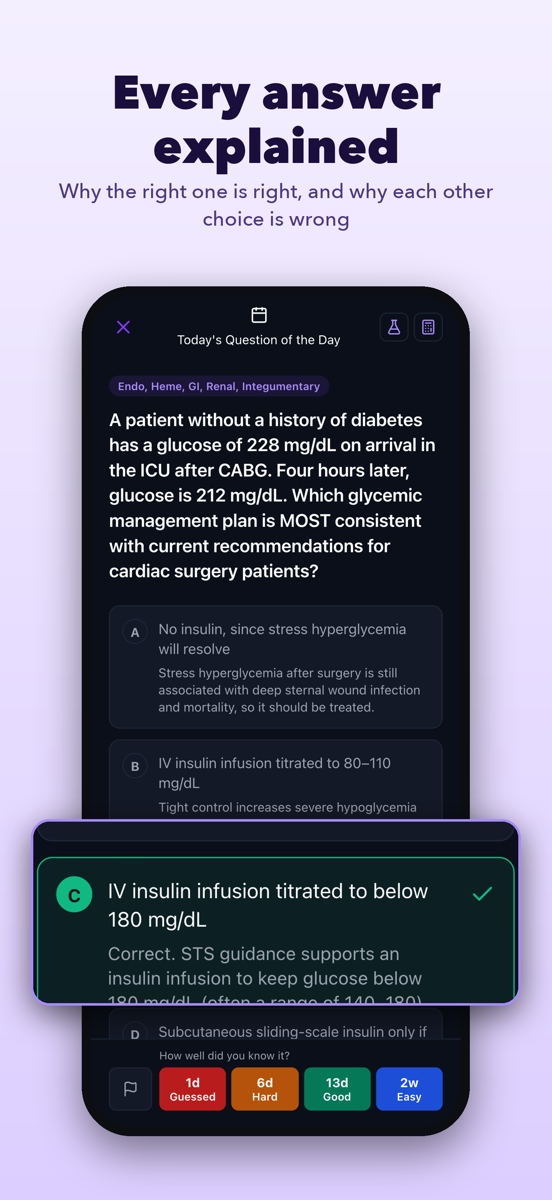
Every question is a clinical scenario with one best answer, written to the application-and-analysis level the exams test, and every option explains why it is right or wrong.

Full-length mock exams

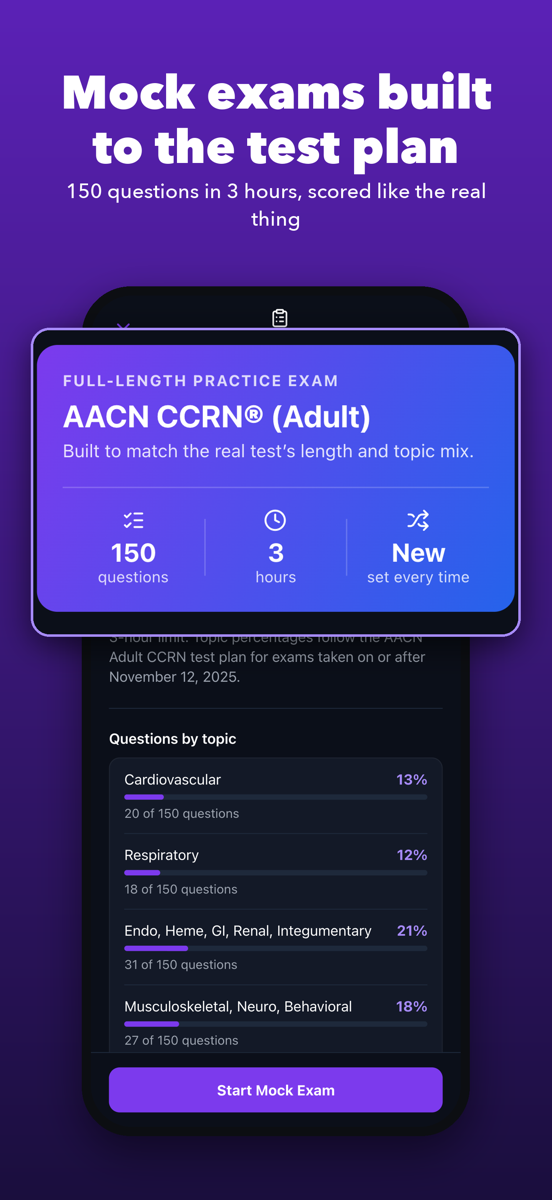
The same number of questions, time limit and topic mix as the real test: 150 in 3 hours for the CCRN and PCCN, 90 in 2 hours for the CMC and CSC. A new set every time, and you can leave and pick up where you left off.

Know where you stand

Accuracy by topic, mock exam scores over time, and a readiness estimate weighted to the exam's blueprint, with your weakest topic called out.

A plan that fits your exam date

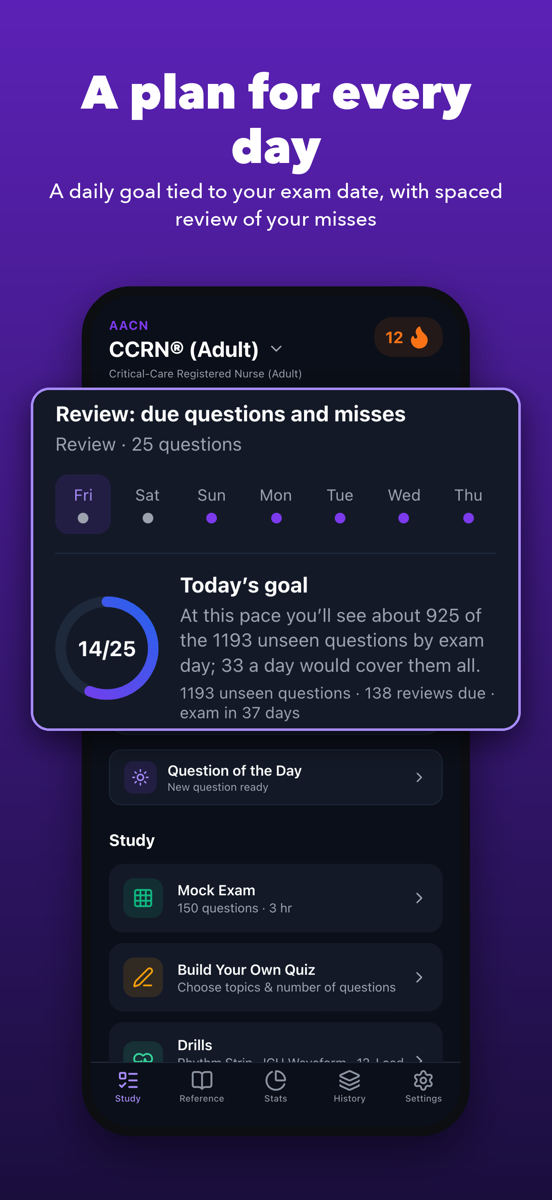
Choose a daily goal: finish the bank by exam day, or a set number of questions. One tap starts a session, and spaced repetition brings misses back right before you would forget them.

Everything else in the app

Rhythm strips & waveforms

ECG rhythms, arterial and PA waveforms, IABP and Impella, and capnography, drawn right in the app. Timed Rhythm Strip and ICU Waveform drills sweep like a live monitor, so you learn to read them, not just name them.

A full study reference

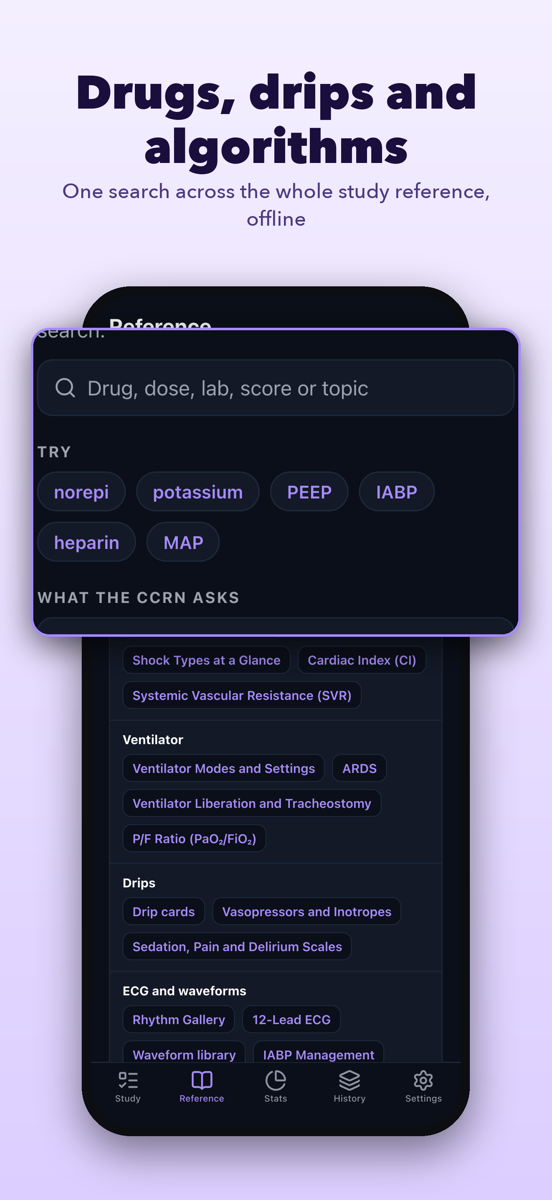
100+ drugs, 46 drips, 39 algorithms and 100+ calculators, from cardiac index and SVR to corrected sodium and anion gap, with formulas and what each result means. Search it all in one place. For education only.

Private by design

No account and no sign-in. Your progress stays on your device, and you can back it up to a file and restore it on a new phone. The only data sent is anonymous usage analytics, which you can turn off in Settings.

Sources and cheat sheets

Every rationale lists the guidelines and texts behind it, and cheat sheets cover high-yield topics from ECMO, Impella and CRRT to sepsis, shock and ABGs.

A look inside

Tap any key term in an explanation for a quick definition. Flag questions, add notes, and search the whole bank.

Mock exam intro with topic breakdown
Mock exams built to the test plan
Answered question with rationales for each option
Rationales for every choice
Study plan with today's goal and reviews due
A daily plan to exam day
Reference search across drugs, drips and algorithms
Drugs, drips and algorithms

Exams covered: CCRN, PCCN, CEN, CMC, CSC, ACLS and the NBRC RT exam

Switch exams any time. Questions that fit more than one exam appear in each, mapped to that exam's topics.

AACN

CCRN (Adult)

1,671 questions · 150-question, 3-hour mock exams on the current test plan

Exam guide · Sample questions

AACN

PCCN

853 questions · progressive-care content, 150-question mock exams

Exam guide · Sample questions

AACN

CMC

851 questions · cardiac medicine subspecialty, 90-question mock exams

Exam guide · Sample questions

AACN

CSC

592 questions · cardiac surgery subspecialty, 90-question mock exams

Exam guide · Sample questions

AHA

ACLS

551 questions · algorithms, rhythms and drugs updated to the 2025 guidelines, 50-question mock exams

Exam guide · Sample questions

NBRC

Respiratory Therapy Exam (RTE)

999 questions · built to the 2027 content outline that replaces the TMC and CSE, with 160-question, 4-hour mock exams; the bank is growing

Exam guide · Sample questions

BCEN

CEN

1,088 questions · emergency nursing, 175-question, 3-hour mock exams on the July 2026 outline

Exam guide · Sample questions

Practice

ICU Basics

4,512 questions · fundamentals for new critical care nurses and students

Coming

CCRN (Pediatric)

In development

Coming

CCRN (Neonatal)

In development

Latest from the blog

Test plan

CMC Test Plan 2026: Domain Breakdown and Study Plan

The CMC test plan for exams from November 19, 2026: the four domains with weights and item counts, what each covers, and a study plan built on the numbers.

Choosing an exam

CCRN vs PCCN: Which Exam Fits Your Unit

CCRN vs PCCN: how patient acuity, not your unit name, decides eligibility, how the hours work, how the test plans differ, and which exam to take first.

Test plan

CEN Exam Blueprint: Content Areas, Percentages, How to Study

The CEN exam blueprint from July 2026: all 11 content areas with item counts and percentages, what changed from 2022, and a study plan built on the weights.

All posts

CCRN, PCCN and CEN practice questions: common questions

Is ICU Basics really free?

Today, yes: no ads and no account needed, on the App Store, on Google Play and in the web app. In January 2027 a paid plan, ICU Basics Pro, starts. The question of the day, the daily plan, the full Reference and one mock exam stay free; more mock exams, quick, timed and custom quizzes and drills become part of Pro. People who use ICU Basics before then keep everything free through January 31, then get a discount on Pro.

Are these the real exam questions?

No. Every question is original, written to the published test plans and the application-and-analysis style of the exams, then reviewed for accuracy and for the "tells" that let test-wise nurses guess. ICU Basics is an independent study tool and is not affiliated with the certifying bodies.

How are the mock exams built?

Each mock draws a fresh set at random, with the number of questions per topic matched to the percentages in the official test plan and the same time limit as the real exam. You can skip, go back, flag, and review everything before you submit, and you can leave and resume later.

Do I need an account? Does it work offline?

No account, and yes: everything ships with the app and runs on your device. Your study progress never leaves your device; the only data sent is anonymous usage analytics, which you can turn off in Settings → Your Data. Use Settings → Back up progress to save a file to iCloud Drive or Files before switching phones.

What does the readiness estimate mean?

It blends your recent mock exam scores with your topic accuracy, weighted to the exam's blueprint, and shows how much data it is based on. It is an estimate of current performance to guide your studying, not a prediction that you will pass.

Who makes ICU Basics?

ICU Basics is published by Grip Theory LLC, which also makes RN Basics and Medic Basics. The clinical reviewer is Alex G, BSN, RN, CEN, CCRN, CMC, NREMT-P, an ICU nurse. How questions are written and reviewed.

I think a question is wrong.

Tap "Report a problem with this question" under any explanation. It opens an email with the question already filled in, and every report is reviewed.

Is there an Android version?

Yes. ICU Basics is on Google Play and on the App Store for iPhone and iPad, and the web app works in any browser.

Study with a plan, not a pile.

Set your exam date, pick a daily goal, and let the app keep you on track.

Practice free in your browser

Download on theApp Store Get it onGoogle Play