 ICU Basics
Cheat Sheet
Bladder Pressure and Abdominal Compartment Syndrome
Who needs bladder pressures, how to measure one, IAH grades, abdominal perfusion pressure, nursing measures and when to call
Practice 5 Bladder Pressure and Abdominal Compartment Syndrome questions
What you will do
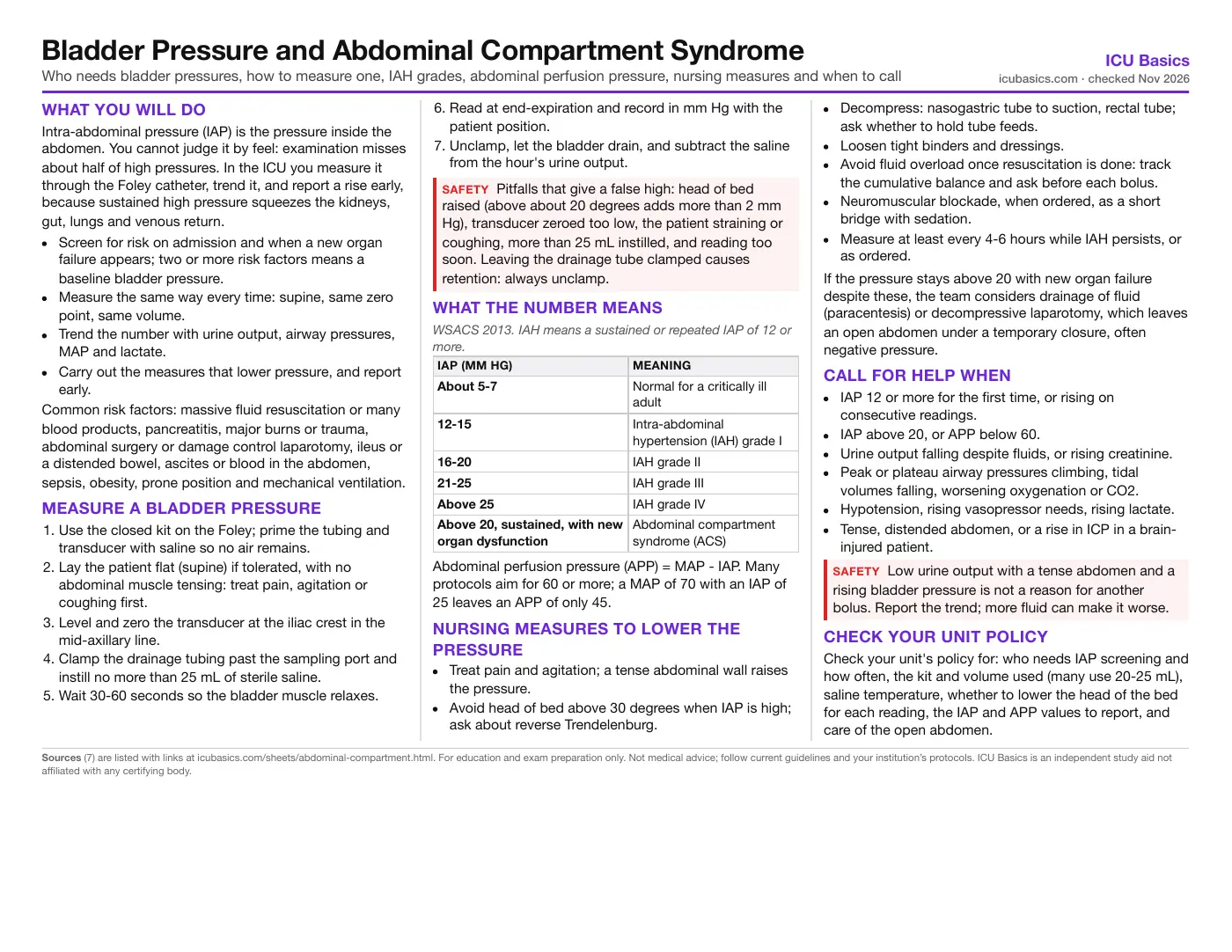
Intra-abdominal pressure (IAP) is the pressure inside the abdomen. You cannot judge it by feel: examination misses about half of high pressures. In the ICU you measure it through the Foley catheter, trend it, and report a rise early, because sustained high pressure squeezes the kidneys, gut, lungs and venous return.
- Screen for risk on admission and when a new organ failure appears; two or more risk factors means a baseline bladder pressure.
- Measure the same way every time: supine, same zero point, same volume.
- Trend the number with urine output, airway pressures, MAP and lactate.
- Carry out the measures that lower pressure, and report early.
Common risk factors: massive fluid resuscitation or many blood products, pancreatitis, major burns or trauma, abdominal surgery or damage control laparotomy, ileus or a distended bowel, ascites or blood in the abdomen, sepsis, obesity, prone position and mechanical ventilation.
Measure a bladder pressure
- Use the closed kit on the Foley; prime the tubing and transducer with saline so no air remains.
- Lay the patient flat (supine) if tolerated, with no abdominal muscle tensing: treat pain, agitation or coughing first.
- Level and zero the transducer at the iliac crest in the mid-axillary line.
- Clamp the drainage tubing past the sampling port and instill no more than 25 mL of sterile saline.
- Wait 30-60 seconds so the bladder muscle relaxes.
- Read at end-expiration and record in mm Hg with the patient position.
- Unclamp, let the bladder drain, and subtract the saline from the hour's urine output.
What the number means
| IAP (mm Hg) | Meaning |
|---|---|
| About 5-7 | Normal for a critically ill adult |
| 12-15 | Intra-abdominal hypertension (IAH) grade I |
| 16-20 | IAH grade II |
| 21-25 | IAH grade III |
| Above 25 | IAH grade IV |
| Above 20, sustained, with new organ dysfunction | Abdominal compartment syndrome (ACS) |
Abdominal perfusion pressure (APP) = MAP - IAP. Many protocols aim for 60 or more; a MAP of 70 with an IAP of 25 leaves an APP of only 45.
Nursing measures to lower the pressure
- Treat pain and agitation; a tense abdominal wall raises the pressure.
- Avoid head of bed above 30 degrees when IAP is high; ask about reverse Trendelenburg.
- Decompress: nasogastric tube to suction, rectal tube; ask whether to hold tube feeds.
- Loosen tight binders and dressings.
- Avoid fluid overload once resuscitation is done: track the cumulative balance and ask before each bolus.
- Neuromuscular blockade, when ordered, as a short bridge with sedation.
- Measure at least every 4-6 hours while IAH persists, or as ordered.
If the pressure stays above 20 with new organ failure despite these, the team considers drainage of fluid (paracentesis) or decompressive laparotomy, which leaves an open abdomen under a temporary closure, often negative pressure.
Call for help when
- IAP 12 or more for the first time, or rising on consecutive readings.
- IAP above 20, or APP below 60.
- Urine output falling despite fluids, or rising creatinine.
- Peak or plateau airway pressures climbing, tidal volumes falling, worsening oxygenation or CO2.
- Hypotension, rising vasopressor needs, rising lactate.
- Tense, distended abdomen, or a rise in ICP in a brain-injured patient.
Check your unit policy
Check your unit's policy for: who needs IAP screening and how often, the kit and volume used (many use 20-25 mL), saline temperature, whether to lower the head of the bed for each reading, the IAP and APP values to report, and care of the open abdomen.
In depth
The one-page summary above is what the PDF prints. These sections go further.
Why high abdominal pressure harms every organ
The abdomen behaves like a closed box with a stretchable wall. Once the wall and diaphragm stop giving, small added volumes (edematous bowel, ascites, blood, gas, resuscitation fluid) cause large rises in pressure. Kidneys: venous outflow and perfusion fall, so oliguria is often the first sign. Lungs: the diaphragm is pushed up, so peak and plateau pressures rise and compliance falls. Heart: venous return falls and afterload rises, so cardiac output drops while CVP and PAOP read falsely high. Gut: poor perfusion causes more edema and leak, a vicious cycle. Brain: higher chest pressure raises ICP.
- Primary IAH or ACS: from disease or injury in the abdomen or pelvis (trauma, bleeding, pancreatitis); often needs early surgery or drainage.
- Secondary: from outside the abdomen, usually capillary leak and large-volume resuscitation (sepsis, burns).
- Recurrent: returns after earlier surgical or medical treatment.
Getting an accurate reading
The bladder method is the WSACS reference standard because it is simple, cheap and reproducible. Every step is standardized so readings can be compared over time and between nurses.
| Factor | Effect | Fix |
|---|---|---|
| Head of bed raised | About 3-4 mm Hg higher at 30 degrees in one study | Read flat; same position every time; document it |
| Zero point | Mid-axillary line read about 2 mm Hg above symphysis pubis in one study | Iliac crest in the mid-axillary line, every time |
| Instilled volume | Bias grows with volume; clinically relevant from about 75 mL | No more than 25 mL |
| Reading too soon | Bladder muscle still contracting | Wait 30-60 seconds |
| Breathing, coughing, straining | Contraction raises the reading | End-expiration, calm patient |
| Air in the tubing | Damped or wrong value | Prime fully; flush air from the catheter |
Prone position also raises IAP. If the reading jumps, check the technique and repeat it before you call; if it is confirmed, report it.
Medical management in steps
The WSACS medical management algorithm works in steps, escalating if the pressure does not fall, and aims for an IAP of 15 or less.
| Goal | Examples |
|---|---|
| Empty the gut | NG and rectal tubes, prokinetics, enemas, colonoscopic decompression, reduce or stop enteral feeds |
| Remove abdominal fluid | Ultrasound or CT to find it, percutaneous catheter drainage |
| Make the wall more compliant | Sedation and analgesia, remove constrictive dressings or eschar, reverse Trendelenburg, neuromuscular blockade |
| Fluid balance | Avoid excess fluid; aim for zero to negative balance by about day 3 once stable; diuresis or ultrafiltration |
| Perfusion | Goal-directed resuscitation with hemodynamic monitoring |
Neuromuscular blockade relaxes the abdominal wall and can lower IAP quickly, but WSACS suggests only brief trials as a bridge. In massive hemorrhage, a higher plasma to red cell ratio and limited crystalloid are suggested, which also limits bowel edema.
Decompressive laparotomy and the open abdomen
Decompressive laparotomy is recommended for overt ACS. Pressure falls at once, but mortality remains high (up to about 50%). The abdomen is left open under a temporary closure, and negative pressure wound therapy is recommended; the goal is to close the fascia during the same hospital stay.
- Watch for recurrent ACS: keep measuring bladder pressures after decompression.
- Count canister output as fluid loss; it can carry a lot of fluid and protein.
- Keep the seal intact; report leaks, bleeding, or bowel contents in the canister (fistula).
- Watch for reperfusion after decompression: hypotension, arrhythmia, acidosis.
- Protect the skin, keep the patient sedated as ordered, and follow the surgeon's orders for dressing changes.
Monitoring tips and evidence
- High IAP makes filling pressures misleading: CVP and PAOP read high while the patient may be dry. WSACS suggests transmural values (pressure minus half the IAP).
- High plateau pressure from a stiff chest wall does not always mean stiff lungs; the team may use transmural plateau pressure (Pplat - 0.5 x IAP).
- Skip the bladder method if the bladder is injured, or ask about another route (gastric) when the bladder is not usable.
- WSACS 2013 is still the latest published consensus; an update is under way. A 2024 international WSACS survey did not reach agreement on changing the normal value to 10 mm Hg, so 5-7 remains the stated normal.
- WSACS made no formal recommendation on APP as a resuscitation endpoint; APP 60 is a common protocol target.
Related cheat sheets
- Sepsis and Septic Shock BundleSepsis-3 definitions, the Hour-1 bundle and SSC 2026 changes for exam review
- Preventing ICU InfectionsCLABSI, CAUTI, VAE, C. difficile and MDRO bundles, isolation by organism, hand hygiene and quality measures
- Acute Kidney InjuryKDIGO staging, causes, urine studies, nephrotoxins, prevention, dialysis timing and nursing care for critical care exams
- Electrolyte ImbalancesNa, K, Ca, Mg and phos: normals, ECG clues, safe replacement, hyperkalemia steps
- CRRT (Continuous Renal Replacement)Modes, dose, circuit pressures, citrate and nursing care for critical care exams
- DKA and HHS2024 consensus criteria, treatment order, potassium, euglycemic DKA and monitoring
Calculators for this topic
Sources
- Kirkpatrick AW, Roberts DJ, De Waele J, et al. Intra-abdominal hypertension and the abdominal compartment syndrome: updated consensus definitions and clinical practice guidelines from the World Society of the Abdominal Compartment Syndrome. Intensive Care Med. 2013;39(7):1190–1206. Link
- World Society of the Abdominal Compartment Syndrome. Intra-abdominal hypertension (IAH) assessment algorithm (adapted from Intensive Care Med 2006 and 2007), NHS Scotland copy. Link
- Tichenor MD, Cheatham ML, Smith C. Intra-abdominal pressure monitoring: evidence based medicine guideline. SurgicalCriticalCare.net; revised October 2023. Link
- Malbrain MLNG, Deeren DH. Effect of bladder volume on measured intravesical pressure: a prospective cohort study. Crit Care. 2006;10(4):R98. Link
- Rooban N, Regli A, Davis WA, De Keulenaer BL. Comparing intra-abdominal pressures in different body positions via a urinary catheter and nasogastric tube: a pilot study. Ann Intensive Care. 2012;2(Suppl 1):S11. Link
- Soler Morejón C, Lombardo TA, Tamargo Barbeito TO, Barquín García S. Effects of zero reference position on bladder pressure measurements: an observational study. Ann Intensive Care. 2012;2(Suppl 1):S13. Link
- Nasa P, Wise RD, Smit M, et al. International cross-sectional survey on current and updated definitions of intra-abdominal hypertension and abdominal compartment syndrome. World J Emerg Surg. 2024;19:39. Link