 ICU Basics
Cheat Sheet
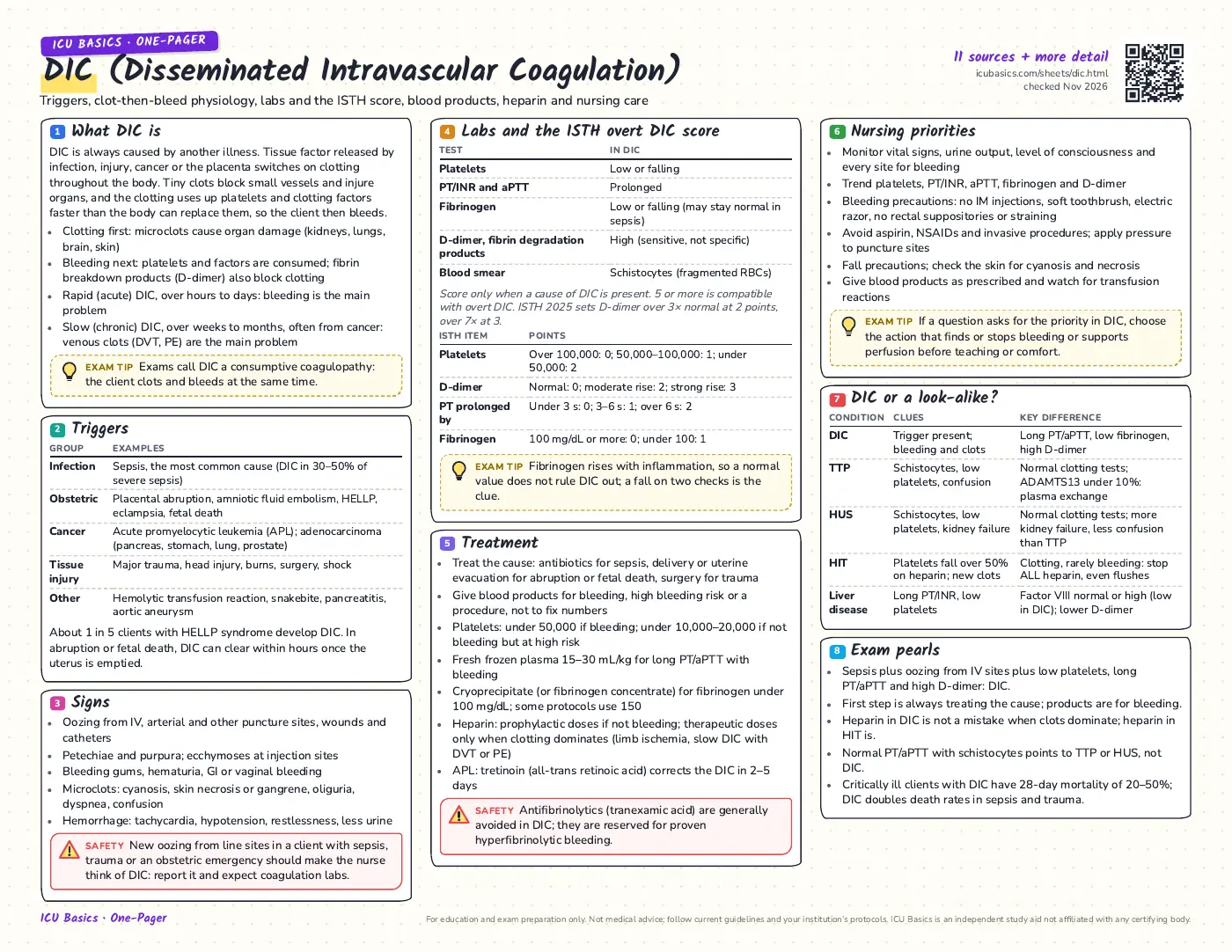
DIC (Disseminated Intravascular Coagulation)
Triggers, clot-then-bleed physiology, labs and the ISTH score, blood products, heparin and nursing care
Practice 6 DIC (Disseminated Intravascular Coagulation) questions free
What DIC is
DIC is always caused by another illness. Tissue factor released by infection, injury, cancer or the placenta switches on clotting throughout the body. Tiny clots block small vessels and injure organs, and the clotting uses up platelets and clotting factors faster than the body can replace them, so the client then bleeds.
- Clotting first: microclots cause organ damage (kidneys, lungs, brain, skin)
- Bleeding next: platelets and factors are consumed; fibrin breakdown products (D-dimer) also block clotting
- Rapid (acute) DIC, over hours to days: bleeding is the main problem
- Slow (chronic) DIC, over weeks to months, often from cancer: venous clots (DVT, PE) are the main problem
Triggers
| Group | Examples |
|---|---|
| Infection | Sepsis, the most common cause (DIC in 30–50% of severe sepsis) |
| Obstetric | Placental abruption, amniotic fluid embolism, HELLP, eclampsia, fetal death |
| Cancer | Acute promyelocytic leukemia (APL); adenocarcinoma (pancreas, stomach, lung, prostate) |
| Tissue injury | Major trauma, head injury, burns, surgery, shock |
| Other | Hemolytic transfusion reaction, snakebite, pancreatitis, aortic aneurysm |
About 1 in 5 clients with HELLP syndrome develop DIC. In abruption or fetal death, DIC can clear within hours once the uterus is emptied.
Signs
- Oozing from IV, arterial and other puncture sites, wounds and catheters
- Petechiae and purpura; ecchymoses at injection sites
- Bleeding gums, hematuria, GI or vaginal bleeding
- Microclots: cyanosis, skin necrosis or gangrene, oliguria, dyspnea, confusion
- Hemorrhage: tachycardia, hypotension, restlessness, less urine
Labs and the ISTH overt DIC score
| Test | In DIC |
|---|---|
| Platelets | Low or falling |
| PT/INR and aPTT | Prolonged |
| Fibrinogen | Low or falling (may stay normal in sepsis) |
| D-dimer, fibrin degradation products | High (sensitive, not specific) |
| Blood smear | Schistocytes (fragmented RBCs) |
| ISTH item | Points |
|---|---|
| Platelets | Over 100,000: 0; 50,000–100,000: 1; under 50,000: 2 |
| D-dimer | Normal: 0; moderate rise: 2; strong rise: 3 |
| PT prolonged by | Under 3 s: 0; 3–6 s: 1; over 6 s: 2 |
| Fibrinogen | 100 mg/dL or more: 0; under 100: 1 |
Treatment
- Treat the cause: antibiotics for sepsis, delivery or uterine evacuation for abruption or fetal death, surgery for trauma
- Give blood products for bleeding, high bleeding risk or a procedure, not to fix numbers
- Platelets: under 50,000 if bleeding; under 10,000–20,000 if not bleeding but at high risk
- Fresh frozen plasma 15–30 mL/kg for long PT/aPTT with bleeding
- Cryoprecipitate (or fibrinogen concentrate) for fibrinogen under 100 mg/dL; some protocols use 150
- Heparin: prophylactic doses if not bleeding; therapeutic doses only when clotting dominates (limb ischemia, slow DIC with DVT or PE)
- APL: tretinoin (all-trans retinoic acid) corrects the DIC in 2–5 days
Nursing priorities
- Monitor vital signs, urine output, level of consciousness and every site for bleeding
- Trend platelets, PT/INR, aPTT, fibrinogen and D-dimer
- Bleeding precautions: no IM injections, soft toothbrush, electric razor, no rectal suppositories or straining
- Avoid aspirin, NSAIDs and invasive procedures; apply pressure to puncture sites
- Fall precautions; check the skin for cyanosis and necrosis
- Give blood products as prescribed and watch for transfusion reactions
DIC or a look-alike?
| Condition | Clues | Key difference |
|---|---|---|
| DIC | Trigger present; bleeding and clots | Long PT/aPTT, low fibrinogen, high D-dimer |
| TTP | Schistocytes, low platelets, confusion | Normal clotting tests; ADAMTS13 under 10%: plasma exchange |
| HUS | Schistocytes, low platelets, kidney failure | Normal clotting tests; more kidney failure, less confusion than TTP |
| HIT | Platelets fall over 50% on heparin; new clots | Clotting, rarely bleeding: stop ALL heparin, even flushes |
| Liver disease | Long PT/INR, low platelets | Factor VIII normal or high (low in DIC); lower D-dimer |
Exam pearls
- Sepsis plus oozing from IV sites plus low platelets, long PT/aPTT and high D-dimer: DIC.
- First step is always treating the cause; products are for bleeding.
- Heparin in DIC is not a mistake when clots dominate; heparin in HIT is.
- Normal PT/aPTT with schistocytes points to TTP or HUS, not DIC.
- Critically ill clients with DIC have 28-day mortality of 20–50%; DIC doubles death rates in sepsis and trauma.
In depth
The one-page summary above is what the PDF prints. These sections go further.
Pathophysiology in more detail
Tissue factor from damaged endothelium, monocytes in sepsis, tumor cells or placental tissue activates factor VII and the extrinsic pathway, making thrombin and fibrin. Natural anticoagulants (antithrombin, the protein C system) are consumed or suppressed, and in sepsis plasminogen activator inhibitor-1 rises and blocks fibrinolysis, so clots persist in small vessels and organs fail. Where fibrinolysis is strong, plasmin breaks fibrin into D-dimer and other degradation products, which themselves impair platelets and add to bleeding. RBCs forced through fibrin strands fragment into schistocytes.
| Type (ISTH 2025) | Typical causes | Picture |
|---|---|---|
| Thrombotic (fibrinolysis suppressed) | Sepsis | Organ failure, modest bleeding; fibrinogen often normal |
| Hemorrhagic (fibrinolysis enhanced) | APL and other blood cancers, amniotic fluid embolism, transfusion reactions | Oozing and hemorrhage; very low fibrinogen, very high D-dimer |
The ISTH 2025 definition also stages DIC as pre-DIC, early and overt, so that treatment can start before the overt score is reached.
Sepsis-induced coagulopathy (SIC) score
| Item | 1 point | 2 points |
|---|---|---|
| Platelets | 100,000–149,000 | Under 100,000 |
| PT ratio (INR) | Over 1.2 to 1.4 | Over 1.4 |
| SOFA (respiratory, cardiovascular, liver, kidney) | 1 | 2 or more |
Replacement and anticoagulation: the evidence
Platelets and plasma have never been shown to fuel DIC, but no high-quality trial guides thresholds. ISTH 2013 and the British guideline (2009) reserve products for bleeding, high bleeding risk or procedures. Fibrinogen under 1 g/L (100 mg/dL) that persists after plasma is treated with fibrinogen concentrate or cryoprecipitate. Prothrombin complex concentrate replaces only some factors and is not a routine choice (Merck cites thrombosis risk).
Heparin: prophylactic UFH or LMWH for critically ill clients who are not bleeding; therapeutic doses where thrombosis predominates or in slow DIC with venous or arterial clots. Merck notes one exception in bleeding DIC: a retained dead fetus with steadily falling platelets and fibrinogen, where heparin is given for several days before the uterus is evacuated. Antithrombin, activated protein C (withdrawn) and recombinant thrombomodulin have not improved survival in large trials.
Related cheat sheets
- Sepsis and Septic Shock BundleSepsis-3 definitions, the Hour-1 bundle and SSC 2026 changes for exam review
- Preventing ICU InfectionsCLABSI, CAUTI, VAE, C. difficile and MDRO bundles, isolation by organism, hand hygiene and quality measures
- Acute Kidney InjuryKDIGO staging, causes, urine studies, nephrotoxins, prevention, dialysis timing and nursing care for critical care exams
- Electrolyte ImbalancesNa, K, Ca, Mg and phos: normals, ECG clues, safe replacement, hyperkalemia steps
- CRRT (Continuous Renal Replacement)Modes, dose, circuit pressures, citrate and nursing care for critical care exams
- DKA and HHS2024 consensus criteria, treatment order, potassium, euglycemic DKA and monitoring
Calculators for this topic
Sources
- Costello RA, Leslie SW, Nehring SM. Disseminated Intravascular Coagulation. StatPearls. Treasure Island (FL): StatPearls Publishing; updated May 1, 2024. Link
- Merck Manual Professional Version. Disseminated Intravascular Coagulation (DIC). Full review Jul 2025. Link
- Papageorgiou C, Jourdi G, Adjambri E, et al. Disseminated Intravascular Coagulation: An Update on Pathogenesis, Diagnosis, and Therapeutic Strategies. Clin Appl Thromb Hemost. 2018;24(9 suppl):8S-28S. Link
- Wada H, Thachil J, Di Nisio M, et al. Guidance for diagnosis and treatment of DIC from harmonization of the recommendations from three guidelines (ISTH SSC on DIC). J Thromb Haemost. 2013;11(4):761-767. Link
- Levi M, Toh CH, Thachil J, Watson HG. Guidelines for the diagnosis and management of disseminated intravascular coagulation. Br J Haematol. 2009;145(1):24-33. Link
- Iba T, Maier CL, Scarlatescu E, Levy JH. The ISTH 2025 definition and diagnostic criteria of disseminated intravascular coagulation. Semin Thromb Hemost. 2026;52(1):10-17. Link
- Iba T, Levy JH, Raj A, Warkentin TE. Advance in the Management of Sepsis-Induced Coagulopathy and Disseminated Intravascular Coagulation. J Clin Med. 2019;8(5):728. Link
- Merck Manual Professional Version. Acute Myeloid Leukemia (AML). Full review Feb 2026. Link
- Merck Manual Professional Version. Thrombotic Thrombocytopenic Purpura (TTP). Full review Jun 2026. Link
- Merck Manual Professional Version. Thrombocytopenia: Other Causes (heparin-induced thrombocytopenia). Link
- Open Resources for Nursing (Open RN). Health Alterations, 3.10 Thrombocytopenia: bleeding precautions. Link