 ICU Basics
Video explainer · Labs and electrolytes
Electrolytes Explained: Sodium, Potassium, Calcium, Phos & Magnesium
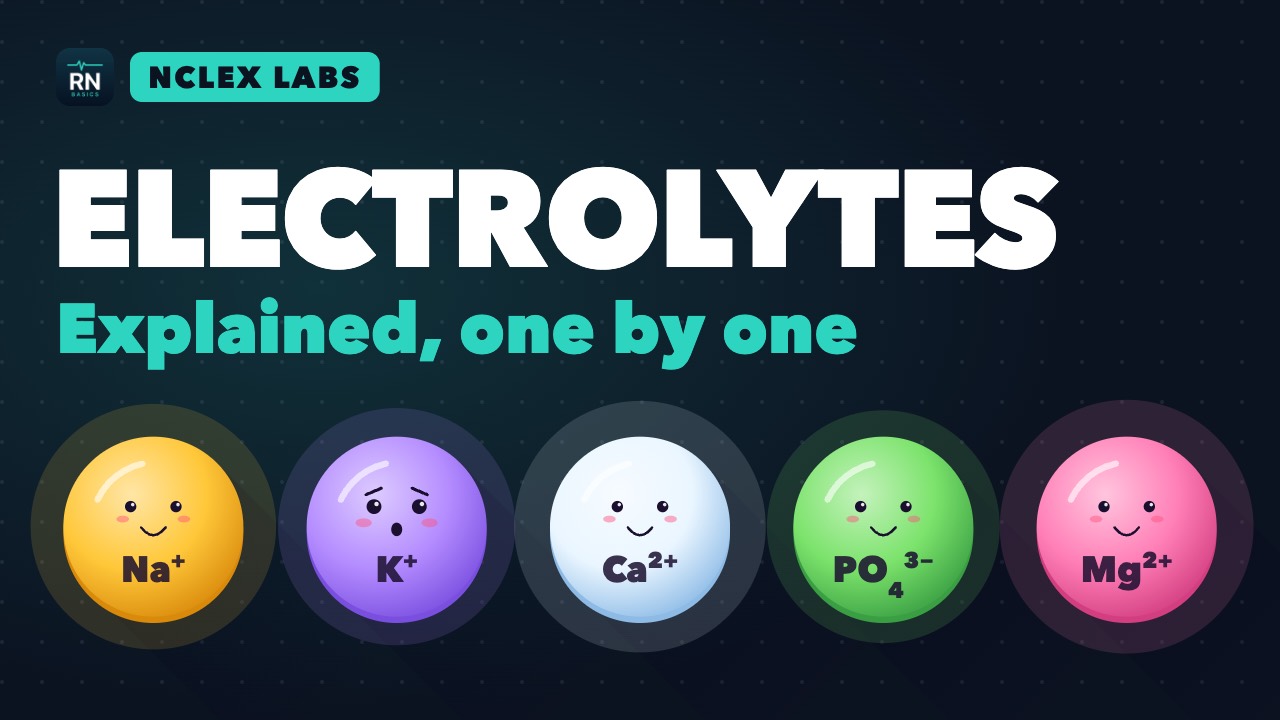
Five lab values, and any one of them can cause seizures, respiratory failure or a deadly rhythm. Fix one too fast and you can cause harm yourself.
This video covers each electrolyte’s normal range, main causes, signs and ECG changes, and priority treatment with the nursing safety points: why sodium has to be corrected slowly (osmotic demyelination) and how 3% saline is used, why potassium is never given IV push and how labels cap the rate, calcium gluconate vs calcium chloride, phosphate and failure to wean, magnesium for torsades de pointes and the signs of magnesium toxicity. Then how they connect: magnesium and potassium, magnesium and calcium, calcium and phosphate, the QT, and refeeding syndrome.
Chapters
- 0:00 Five electrolytes that can stop a heart
- 0:22 Sodium: water follows sodium, safe correction
- 2:01 Potassium: ECG changes, never IV push
- 3:34 Calcium: tetany, QT, gluconate vs chloride
- 5:12 Phosphorus: weak breathing muscles, binders
- 6:07 Magnesium: torsades and toxicity
- 7:19 How they connect: Mg, K, Ca, phosphate, refeeding
- 8:40 Recap
Study the topic
In the Reference
- Potassium chloride
- Calcium gluconate
- Calcium chloride
- Magnesium sulfate
- Hypertonic saline
- Magnesium sulfate drip
- Hypertonic saline 3% drip
- Hyperkalemia
- Chemistry lab values
Transcript
Five electrolytes that can stop a heart
0:00 Five lab values: sodium, potassium, calcium, phosphorus, and magnesium. Get one badly wrong, and the patient can seize, stop breathing, or slip into a deadly rhythm. Fix one too fast, and you can cause the harm yourself. Ranges vary by lab, so use your own lab’s range.
Sodium: water follows sodium, safe correction
0:24 Sodium first. Normal is about 135 to 145 mEq/L. The key idea: water follows sodium. When sodium drops, water moves into cells, and brain cells swell.
0:41 Causes of low sodium: diuretics, vomiting, diarrhea, heart failure, cirrhosis, and SIADH. Early on: nausea and headache. When it’s severe: confusion, decreased consciousness, and seizures. Severe symptoms get 3% hypertonic saline in small boluses per protocol, through a large vein, aiming for a rise of about 5.
1:08 Then slow down: in chronic low sodium the brain has adapted, and a rapid rise can cause osmotic demyelination. A common limit is 10 mEq/L in 24 hours, or 8 if high risk: alcohol use, malnutrition, low potassium, or liver disease. Recheck sodium every 2 to 4 hours, and watch for a sudden jump in urine output, a warning sign of overcorrection. High sodium is usually a water problem: no access to water, gut or kidney losses, or diabetes insipidus.
1:45 Brain cells shrink: thirst, irritability, decreased consciousness, and seizures. Lower it gradually too, at most about 0.5 an hour, and 12 in a day, or the brain can swell.
Potassium: ECG changes, never IV push
2:03 Potassium. Normal is about 3.5 to 5.0 mEq/L. High potassium: kidney injury, ACE inhibitors, acidosis, and cell breakdown, like rhabdomyolysis. On the ECG: peaked T waves, then a longer PR, lost P waves, a wide QRS, and finally a sine wave.
2:29 ECG changes don’t track the number closely, so treat any of them as an emergency. First, IV calcium to stabilize the heart. It lasts about 30 to 60 minutes, and doesn’t lower potassium. Next, shift potassium into cells with insulin and dextrose, and check glucose hourly for several hours.
2:51 Nebulized albuterol also shifts it, and dialysis removes it when the kidneys can’t. Low potassium: diuretics, vomiting, diarrhea, insulin, and albuterol. Expect weakness, cramps, flat T waves, ST depression, U waves, and arrhythmias. Never IV push potassium: the concentrate label warns that direct injection may be instantly fatal.
3:19 Always dilute it and use a pump. Labels usually cap the rate at 10 mEq an hour, faster only in urgent cases on continuous ECG monitoring. The most concentrated bags go central only.
Calcium: tetany, QT, gluconate vs chloride
3:37 Calcium. Total calcium is normally about 8.8 to 10.3 mg/dL. Low albumin pulls the total down, so check an ionized calcium when it matters. Low calcium: after thyroid or parathyroid surgery, low magnesium, pancreatitis, kidney failure, and massive transfusion.
4:00 Expect tingling around the mouth and fingers, muscle spasms, and positive Chvostek and Trousseau signs. Severe cases bring laryngospasm and seizures, and the ECG shows a long QT. Symptomatic low calcium is an emergency: IV calcium gluconate over about 10 minutes, on a monitor. Chloride carries about three times the calcium of gluconate: 27 mg per mL, versus 9.3.
4:30 But chloride is harsh on veins. Give it slowly, preferably through a central or deep vein; a leak can cause tissue necrosis. So gluconate is the usual pick for a peripheral IV. Also: with digoxin, avoid calcium, or give it very slowly with ECG monitoring.
4:50 And never with ceftriaxone in the same Y-site. High calcium is mostly hyperparathyroidism or cancer. Expect confusion, nausea, constipation, thirst, lots of urine, and sometimes a short QT. Treat with IV normal saline, then usually a bisphosphonate.
Phosphorus: weak breathing muscles, binders
5:14 Phosphorus. Normal is about 2.8 to 4.5 mg/dL. Low phosphate often comes from a shift into cells: insulin and glucose, refeeding, respiratory alkalosis, or treating DKA. Severe lows weaken the breathing muscles and the heart, so patients can fail to wean from the ventilator.
5:39 Replace it by mouth when it’s moderate, and IV when it’s severe or symptomatic, infused slowly per protocol. Watch calcium as you give it, because phosphate binds it. And if potassium is above 4, use sodium phosphate instead of potassium phosphate. High phosphate is mostly a kidney problem, plus low parathyroid function. Treat with a low-phosphate diet, binders, and dialysis.
Magnesium: torsades and toxicity
6:09 Magnesium. Normal is about 1.7 to 2.2 mg/dL. Low magnesium comes from alcohol use, diarrhea, diuretics, and proton pump inhibitors. Like low calcium: cramps, tetany, positive Chvostek and Trousseau signs, and seizures.
6:30 And the heart: a prolonged QT, atrial fibrillation, and torsades de pointes. Torsades gets IV magnesium, typically 2 grams over minutes, then an infusion, with the defibrillator ready. Outside an emergency, go slower: rapid infusion can drop blood pressure, and the label’s usual cap is 150 mg a minute. High magnesium is mostly kidney failure plus magnesium intake: laxatives, antacids, or IV magnesium in preeclampsia.
7:04 Reflexes fade first. Then blood pressure drops, breathing slows, and the heart can stop. On a magnesium infusion, check the knee-jerk reflex and breathing rate. The antidote is IV calcium.
How they connect: Mg, K, Ca, phosphate, refeeding
7:21 Now, how they connect. Magnesium and potassium: low magnesium makes the kidneys waste potassium, so potassium is hard to raise until magnesium is fixed. So check magnesium, and replace it first or alongside. Magnesium and calcium: low magnesium blunts parathyroid hormone, so calcium falls too.
7:45 Low potassium, magnesium, and calcium can all stretch the QT toward torsades. Calcium and phosphate pull opposite ways: rising phosphate binds calcium, and the pair can deposit in tissues. Then there’s refeeding syndrome: a malnourished patient starts eating, tube feeds, or TPN. Insulin drives phosphate, potassium, and magnesium into cells, and blood levels crash, usually within 2 to 5 days.
8:16 Low phosphate is the hallmark. Heart failure, arrhythmias, and respiratory failure can follow. High risk: a BMI under 16, little or no intake for over 10 days, or low levels before feeding. So give thiamine before feeding, start low and go slow, and check and replace electrolytes daily at first.
Recap
8:42 Recap: correct sodium slowly, never push potassium, fix magnesium alongside it, choose your calcium for the line, and watch phosphate when feeding starts. Practice free with RN Basics, ICU Basics, and Medic Basics.
Sources
- MedlinePlus, Sodium blood test Link
- MedlinePlus, Low blood sodium Link
- Treatment of hyponatremia (Sumi et al., Clin Exp Nephrol 2025) Link
- Hyponatraemia and hypernatraemia in critically ill patients (Overgaard-Steensen & Ring, Crit Care 2013) Link
- 3% Sodium Chloride Injection label (DailyMed) Link
- Hypokalemia: a clinical update (Kardalas et al., Endocr Connect 2018) Link
- Management of hyperkalemia in the acutely ill patient (Dépret et al., Ann Intensive Care 2019) Link
- Potassium Chloride concentrate label (DailyMed) Link
- Potassium Chloride premixed injection label (DailyMed) Link
- MedlinePlus, Potassium blood test Link
- Managing hyponatremia: fast or slow? (Clin Kidney J 2026) Link
- Management of hyperkalemia: strategic clinical actions in real-world practice (Clin Exp Nephrol 2025) Link
- MedlinePlus, Calcium blood test Link
- MedlinePlus, Hypercalcemia Link
- Emergency management of acute hypocalcaemia in adults (Society for Endocrinology, Endocr Connect 2016) Link
- Calcium Gluconate Injection label (DailyMed) Link
- Calcium Chloride 10% Injection label (DailyMed) Link
- Hypercalcemia review (Med Sci Monit 2022) Link
- Severe hypercalcemia in critically ill patients (Mousseaux et al., Ann Intensive Care 2019) Link
- Ceftriaxone for Injection label (DailyMed) Link
- Potassium Phosphates Injection label (DailyMed) Link
- MedlinePlus, Phosphorus blood test Link
- Treatment of hypophosphatemia in the ICU (Geerse et al., Crit Care 2010) Link
- Hyperphosphatemia management in chronic kidney disease (Saudi Pharm J 2016) Link
- MedlinePlus, Magnesium blood test Link
- Hypomagnesemia in critically ill patients (Hansen & Bruserud, J Intensive Care 2018) Link
- Intravenous magnesium for torsade de pointes, scoping review (Circ Rep 2025) Link
- Hypermagnesemia in clinical practice (Medicina 2023) Link
- Magnesium Sulfate 50% Injection label (DailyMed) Link
- The refeeding syndrome, narrative review (Intern Emerg Med 2021) Link
For education and exam preparation only. Not medical advice; follow current guidelines and your institution’s protocols. AI narration; script written and clinically reviewed by Alex G.