Video explainer · Labs and electrolytes
IV Fluids Explained: Isotonic, Hypotonic, Hypertonic (NCLEX)
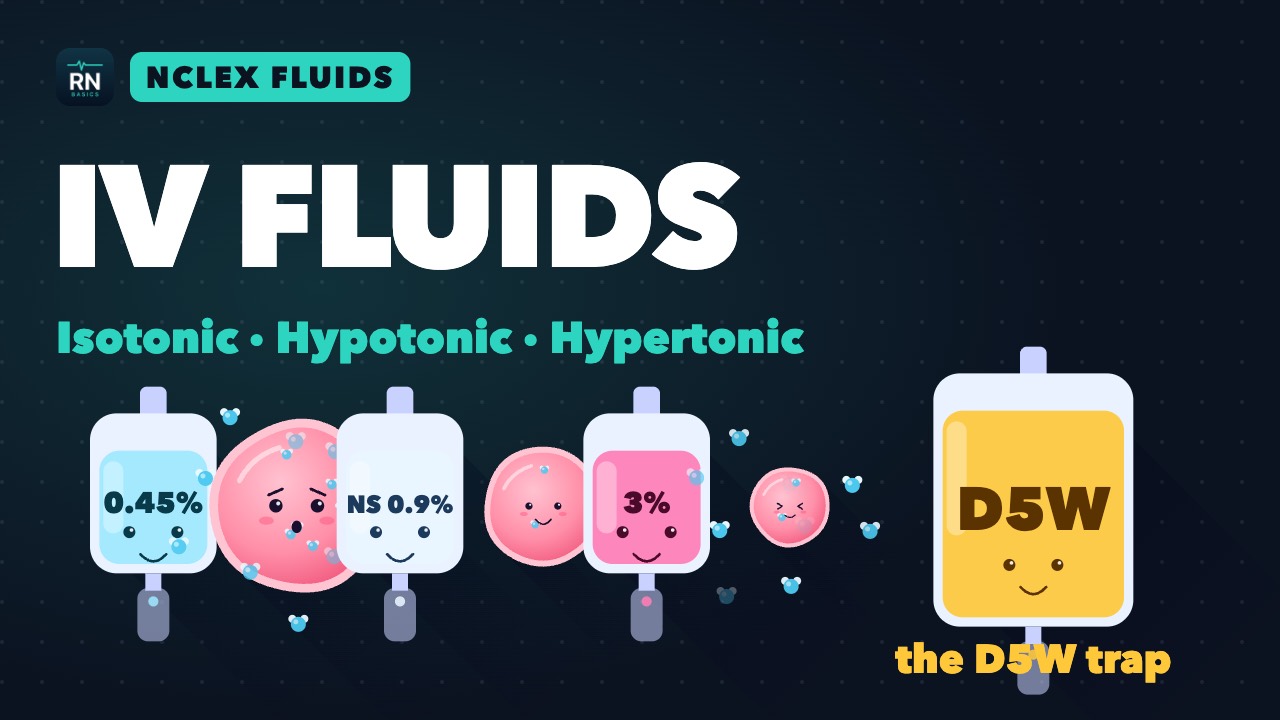
IV fluids look alike in the bag. In the body, one pulls water into cells, one pulls it out, and one leaves it alone.
This video covers osmolarity and tonicity; normal saline, lactated Ringer’s and Plasma-Lyte; hypotonic fluids and why D5W acts hypotonic once the dextrose is used; 3% saline; balanced vs unbalanced crystalloids; what SMART, SALT-ED, BaSICS and PLUS found; lactated Ringer’s myths and real limits; and the NCLEX and paramedic exam traps.
Chapters
- 0:00 IV fluids: where the water goes
- 0:21 Osmolarity and tonicity: which way the water moves
- 1:09 Isotonic fluids: saline, lactated Ringer’s, Plasma-Lyte
- 2:06 Hypotonic fluids and the D5W trap
- 3:08 Hypertonic fluids: 3% saline and D10W
- 4:11 Balanced vs unbalanced: chloride and strong ion difference
- 5:08 The evidence: SMART, SALT-ED, BaSICS, PLUS
- 6:42 Lactated Ringer’s myths and limits
- 8:00 Exam traps: NCLEX, paramedics, local protocol
- 8:59 Recap
Study the topic
In the Reference
Transcript
IV fluids: where the water goes
0:00 IV fluids look alike in the bag. In the body, one pulls water into cells, one pulls it out, and one leaves it alone. Pick the wrong one, and you can swell a brain, shrink a brain, or flood the lungs. Doses and rates are per protocol. This is education, not orders.
Osmolarity and tonicity: which way the water moves
0:23 Osmolarity: how many dissolved particles a liter carries, in mOsm/L. Plasma sits near 290. Tonicity is what the cell feels: whether the fluid outside makes water cross the membrane. Water moves toward the side with more particles.
0:44 Isotonic: no net shift. Cells keep their size. Hypotonic: fewer particles outside, so water moves into cells, and they swell. Hypertonic: more particles outside, so water leaves cells, and they shrink. Brain cells matter most: extra water inside the skull raises intracranial pressure.
Isotonic fluids: saline, lactated Ringer’s, Plasma-Lyte
1:12 Isotonic crystalloids. Normal saline, 0.9%: 154 sodium, 154 chloride, 308 mOsm/L. Lactated Ringer’s: 130 sodium, 4 potassium, 2.7 calcium, 109 chloride, 28 lactate, 273. Plasma-Lyte A: 140 sodium, 5 potassium, 3 magnesium, 98 chloride, acetate and gluconate as buffers, 294.
1:47 These stay in the extracellular space, so they are the fluids for volume: shock, dehydration, and blood loss while blood is on the way. The caution is overload: too much, too fast, and fluid backs up into the lungs. Listen to the lungs, look at the neck veins.
Hypotonic fluids and the D5W trap
2:09 Hypotonic fluids. Half normal saline, 0.45%: 77 sodium, 77 chloride, 154. It gives free water, for a patient who is dry but has enough circulating volume, like high sodium. The classic trap: D5W, 5% dextrose in water.
2:32 In the bag it is about 250, and the label calls it isotonic. But the body burns the dextrose quickly, leaving water, so D5W acts hypotonic. The label says it can become extremely hypotonic and cause hyponatremia. So avoid hypotonic fluids in brain injury or raised intracranial pressure, and in patients prone to low sodium: children, SIADH, after surgery. And lower a high sodium slowly, about 0.5 milliosmoles an hour, or the brain swells the other way.
Hypertonic fluids: 3% saline and D10W
3:11 Hypertonic fluids. 3% sodium chloride: 513 sodium, 513 chloride, 1,027 mOsm/L. It pulls water out of swollen cells. Uses: severe symptomatic low sodium, and raised intracranial pressure.
3:31 Small boluses, through a large vein, per protocol, with sodium checked often. The danger is speed. In chronic low sodium, a rise over about 8 in 24 hours risks osmotic demyelination. For intracranial pressure, serum sodium is usually kept at or below about 155.
3:53 D10W: 505 mOsm/L, hypertonic in the bag. But like D5W, once the sugar is gone only water is left. It is a sugar source, not a volume fluid, and its label also warns of hyponatremia.
Balanced vs unbalanced: chloride and strong ion difference
4:14 Balanced or unbalanced? The difference is chloride and a buffer. Plasma chloride runs about 98 to 106. Saline carries 154, with no buffer.
4:27 Lactated Ringer’s carries 109 chloride plus lactate; Plasma-Lyte 98 chloride plus acetate and gluconate. The body turns those buffers into bicarbonate. The strong ion difference, kept simple: sodium minus chloride. In plasma that gap is about 40.
4:47 In saline, zero. Infuse liters of saline and the gap shrinks, bicarbonate falls, and you get a hyperchloremic metabolic acidosis with a normal anion gap. In studies, high chloride also narrows kidney vessels and lowers filtration, which is why kidney injury became the question.
The evidence: SMART, SALT-ED, BaSICS, PLUS
5:11 The trials. SMART, 2018: 15,800 ICU patients at one center, switching between saline and balanced fluids by month. Death, new dialysis, or lasting kidney damage by day 30: 14.3% balanced versus 15.4% saline. A small difference; no single part was significant alone.
5:37 SALT-ED, same year, 13,300 emergency patients admitted outside the ICU: hospital-free days the same, but fewer major kidney events, 4.7 versus 5.6 percent. BaSICS, 2021: 11,000 ICU patients in Brazil, blinded, Plasma-Lyte versus saline. Death at 90 days: 26.4 versus 27.2 percent. No difference.
6:08 PLUS, 2022: 5,000 ICU patients in Australia and New Zealand, blinded: 21.8 versus 22.0 percent. No difference, in death or new dialysis. Put together: balanced fluids are at least as good, maybe a little better, and saline’s harm shows mostly with large volumes. One exception: traumatic brain injury. In BaSICS, brain-injured patients did worse on the balanced fluid, and reviews favor saline there.
Lactated Ringer’s myths and limits
6:44 Lactated Ringer’s myths and limits. Potassium: a liter carries 4, less than blood. In kidney-transplant studies, the saline group had more hyperkalemia, not less, through acidosis. The limit: the label still says avoid it, or watch potassium, in severe kidney impairment and other hyperkalemia risks.
7:08 Crush-injury protocols pick saline for that reason. Liver: the liver clears the lactate. In severe liver disease that can lag, so the label says avoid or monitor. Lactate levels: the 28 of lactate per liter becomes bicarbonate.
7:26 A rising lactate is the patient, not the bag. Calcium, 2.7 per liter: don’t run it in the same line as citrated blood; it can clot. Ceftriaxone and calcium precipitate: never together in neonates, even on separate lines. In everyone else, not in the same line at once, and flush between.
7:49 Tonicity: 273 in the bag, but in the body about 254, slightly hypotonic. So for brain injury, saline is the usual pick.
Exam traps: NCLEX, paramedics, local protocol
8:02 Exam traps. NCLEX: D5W is isotonic in the bag, hypotonic in the body. Brain swelling or low sodium? D5W is wrong. And hypotonic is never the shock fluid.
8:18 Crackles, neck veins, or new breathlessness during a bolus: stop, reassess, call. 3% saline is high alert: large vein, slow, per protocol, sodium rechecked. Paramedics: isotonic only. Trauma: blood first if you have it; otherwise 500 mL boluses toward a radial pulse, systolic 90, above 110 with a head injury.
8:47 Crush injury: saline, not lactated Ringer’s, because of the potassium. Your local protocol decides which bag and how much; these are the national model guidelines.
Recap
9:02 Recap: tonicity moves water. Isotonic for volume. Hypotonic for free water, never for shock; D5W is hypotonic in the body. Hypertonic for severe low sodium and intracranial pressure, slowly. Balanced for most, saline for brain injury. Know Ringer’s real limits.
9:25 Practice free with RN Basics, ICU Basics, and Medic Basics. Available on the Apple App Store, and Google Play.
Sources
- DailyMed, 0.45% and 0.9% Sodium Chloride Injection USP (Baxter) Link
- DailyMed, 0.9% Sodium Chloride Injection USP (Baxter) Link
- DailyMed, Lactated Ringer’s Injection USP (Baxter) Link
- DailyMed, Plasma-Lyte A Injection pH 7.4 (Baxter) Link
- DailyMed, 5% and 10% Dextrose Injection USP (Baxter) Link
- DailyMed, 5% Dextrose Injection USP (Baxter, 50/100 mL) Link
- DailyMed, 5% Dextrose Injection USP (B. Braun) Link
- DailyMed, 3% Sodium Chloride Injection USP (BD / Fresenius Kabi) Link
- DailyMed, Ceftriaxone for Injection USP (Hikma) Link
- Merck Manual Professional, Intravenous Fluid Resuscitation Link
- Merck Manual Professional, Shock Link
- Merck Manual Professional, Hyponatremia Link
- Merck Manual Professional, Hypernatremia Link
- Merck Manual Professional, Traumatic Brain Injury Link
- Merck Manual Professional, Metabolic Acidosis Link
- MedlinePlus, Low blood sodium Link
- Reddy S, Weinberg L, Young P. Crystalloid fluid therapy. Crit Care 2016 Link
- Weinberg L et al. Plasma-Lyte 148: a clinical review. World J Crit Care Med 2016 Link
- Hoorn EJ. Intravenous fluids: balancing solutions. J Nephrol 2017 Link
- Mayerhöfer T et al. Fluids in the ICU: which is the right one? Nephrol Dial Transplant 2023 Link
- Shin SW et al. Balanced crystalloids versus saline for critically ill patients: an overview of systematic reviews. Crit Care Sci 2026 Link
- SMART: Semler MW et al. Balanced Crystalloids versus Saline in Critically Ill Adults. NEJM 2018 Link
- SALT-ED: Self WH et al. Balanced Crystalloids versus Saline in Noncritically Ill Adults. NEJM 2018 Link
- BaSICS: Zampieri FG et al. JAMA 2021 Link
- BaSICS TBI secondary analysis: Zampieri FG et al. Rev Bras Ter Intensiva 2022 Link
- PLUS: Finfer S et al. Balanced Multielectrolyte Solution versus Saline in Critically Ill Adults. NEJM 2022 Link
- NASEMSO National Model EMS Clinical Guidelines, version 3.0 (March 2022) Link
For education and exam preparation only. Not medical advice; follow current guidelines and your institution’s protocols. AI narration; script written and clinically reviewed by Alex G.