Video explainer · Pharmacology
Vasopressors Made Simple: Receptors, Drugs and MAP Targets
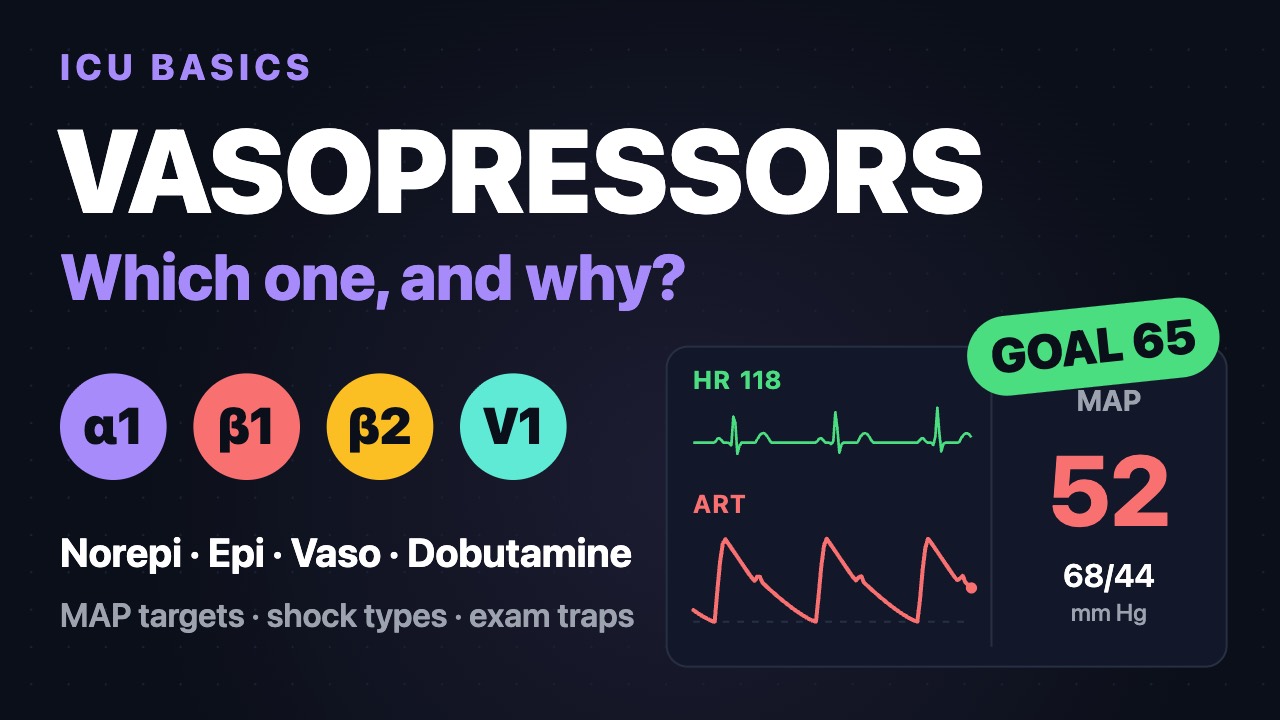
Your patient is in septic shock with a MAP of 52. Which vasopressor do you start, and what is it actually doing?
This video builds vasopressors from the ground up: what blood pressure is made of (MAP ≈ cardiac output × systemic vascular resistance), the five receptors that matter (alpha-1, beta-1, beta-2, D1, V1), seven drugs on one receptor grid (norepinephrine, epinephrine, vasopressin, phenylephrine, dopamine, angiotensin II, and dobutamine as the inotrope contrast), how to choose by shock type, MAP targets from Surviving Sepsis 2021 and 2026, peripheral starts, extravasation and phentolamine, and three common exam traps.
Chapters
- 0:00 Septic shock, MAP 52
- 0:25 What blood pressure is made of
- 1:32 The receptors
- 2:29 The drugs
- 4:33 Choosing by shock type
- 5:53 Targets and monitoring
- 7:03 Three exam traps
- 7:34 Recap
Study the topic
- Vasopressors and InotropesReceptors, doses, SSC 2026 septic shock order, push-dose pressors and extravasation
- Shock Types at a GlanceHemodynamic patterns, exam findings and first treatments for each shock type
In the Reference
- Norepinephrine
- Epinephrine
- Vasopressin
- Phenylephrine
- Norepinephrine drip
- Epinephrine drip
- Vasopressin drip
- Phenylephrine drip
Transcript
Septic shock, MAP 52
0:00 Bed four. Your patient is in septic shock, and the monitor reads a MAP of 52. You've given fluids. The pressure is still low.
0:09 Someone says: start a pressor. But which one? And what is it actually doing inside the body? Let's build vasopressors from the ground up: the physics of pressure, the receptors, the drugs, and how to choose.
What blood pressure is made of
0:27 Start with one relationship. Mean arterial pressure is roughly cardiac output, times systemic vascular resistance. Cardiac output is how much blood the heart pumps each minute. It's heart rate, times stroke volume.
0:43 Stroke volume depends on three things: preload, contractility, and afterload. Preload is how full the heart is before it squeezes. More filling, within limits, means a stronger beat. Contractility is how hard the muscle squeezes.
1:01 Afterload is what the heart pushes against. Tighter arteries mean more afterload. Systemic vascular resistance is that tightness, set mostly by how hard the small arteries squeeze. So there are two big levers. Squeeze the vessels, and resistance rises. Help the heart, and output rises. Either way, pressure goes up. In septic shock, the main problem is vasodilation. The vessels have gone slack.
The receptors
1:35 Vasopressors pull those levers through receptors. Five are worth knowing. alpha-1 receptors sit on the smooth muscle of blood vessels. Stimulate them, and the vessels constrict.
1:47 beta-1 receptors sit mainly on the heart. They raise heart rate and contractility, so cardiac output rises. beta-2 receptors relax smooth muscle. Some blood vessels widen, and the airways open.
2:02 D1 receptors respond to dopamine. They widen the vessels of the kidneys and gut. And V1 receptors respond to vasopressin. They also constrict vascular smooth muscle, but by a separate, non-adrenergic pathway.
2:18 Keep the picture simple. alpha-1 squeezes. beta-1 pumps. beta-2 relaxes. D1 widens. And V1 squeezes another way.
The drugs
2:32 Now let's put the drugs on that grid. Norepinephrine is strongly alpha-1, with moderate beta-1. It tightens the vessels, and gives the heart a modest push. In septic shock, it's the first-line vasopressor.
2:48 Epinephrine hits alpha-1, beta-1, and beta-2. At low doses, the beta effects lead. The heart speeds up and squeezes harder, and resistance can even fall. At higher doses, alpha-1 takes over, and the vessels clamp down.
3:05 The trade-offs: arrhythmias, and a rise in lactate and glucose. Vasopressin has no adrenergic activity at all. It works on V1 receptors. In septic shock, guidelines suggest adding it to norepinephrine, rather than pushing norepinephrine higher.
3:23 Usually around 0.25 to 0.5 mcg/kg/min. Phenylephrine is pure alpha-1. It raises resistance, but does nothing for the pump. As pressure rises, the heart can slow by reflex, and cardiac output can fall.
3:41 Dopamine changes with the dose. Low doses act on dopamine receptors, middle doses on beta-1, and high doses on alpha-1. It causes more arrhythmias than norepinephrine, so it has largely fallen out of favor in septic shock. Angiotensin II constricts vessels through angiotensin type 1 receptors, and raises aldosterone.
4:05 It's an add-on, not a first-line drug, and its label calls for clot prevention. Finally, the contrast: dobutamine. It's mainly beta-1, with some beta-2. It boosts cardiac output, but resistance usually falls, so pressure can drop. Dobutamine is an inotrope, not a vasopressor. Read across any row, and you can predict what that drug will do to the pressure.
Choosing by shock type
4:35 So how do you choose? Start with what's broken. Is the problem the vessels, the pump, or both? Septic shock is vasodilatory. Norepinephrine first, add vasopressin as doses climb, then epinephrine if the MAP is still too low.
4:53 If the heart is also weak, and perfusion stays poor, guidelines suggest adding dobutamine to norepinephrine, or using epinephrine alone. Cardiogenic shock is a pump problem. Norepinephrine is the usual first vasopressor, and an inotrope like dobutamine is added to boost output, once pressure is supported. Anaphylactic shock has its own first drug: epinephrine, intramuscular, 0.5 mg for an adult, in the outer thigh. An IV infusion is for patients who don't respond.
5:27 It treats the whole reaction: alpha-1 for the vessels, beta-1 for the heart, and beta-2 for the airways. Neurogenic shock follows a spinal cord injury that cuts sympathetic tone. The patient is hypotensive, and often bradycardic. Norepinephrine, with its beta-1 effect, is recommended for cervical and thoracic injuries. Pure phenylephrine can slow the heart further.
Targets and monitoring
5:55 Now, the target. For septic shock, Surviving Sepsis recommends an initial MAP target of 65, over higher targets. The 2026 update suggests an initial range of 60 to 65 for patients 65 and older. But the MAP is only a proxy. What you really want is perfusion.
6:18 So watch the patient: mentation, urine output, capillary refill, and a falling lactate. Guidelines also suggest an arterial line, as soon as it's practical. You don't have to wait for a central line. Surviving Sepsis suggests starting vasopressors peripherally, rather than delaying.
6:38 The 2021 guideline adds: for a short time, in a vein at or above the bend of the elbow. And watch that site. If a vasopressor extravasates, the tissue's vessels clamp down, and the skin can blanch and die. The antidote is phentolamine, an alpha blocker. 5 to 10 mg in saline, infiltrated through the area, within 12 hours.
Three exam traps
7:06 Three traps that show up on exams. Trap one: dobutamine is not a vasopressor. It can lower resistance, so a hypotensive patient may need a vasopressor with it. Trap two: phenylephrine can slow the heart.
7:23 Rising pressure, with a falling heart rate, is reflex bradycardia. Trap three: low-dose dopamine does not protect the kidneys. Don't use it for that.
Recap
7:37 Quick recap. MAP is cardiac output, times resistance. alpha-1 squeezes, beta-1 pumps, beta-2 relaxes, and V1 squeezes another way. Norepinephrine first in septic shock, vasopressin next. Epinephrine for anaphylaxis.
7:57 Dobutamine for a failing pump. Aim for a MAP of 65, and treat perfusion, not just the number. ICU Basics. Available on the Apple App Store, and Google Play.
Sources
- Surviving Sepsis Campaign 2021 adult guidelines (Evans et al.) Link
- Surviving Sepsis Campaign 2026 adult guidelines (SCCM) Link
- DailyMed label: norepinephrine Link
- DailyMed label: epinephrine Link
- DailyMed label: vasopressin Link
- DailyMed label: phenylephrine Link
- DailyMed label: dopamine Link
- DailyMed label: angiotensin II Link
- DailyMed label: dobutamine Link
- DailyMed label: phentolamine Link
- Vasopressor and inotropic management in septic shock (P&T 2015) Link
- Approach to hemodynamic shock and vasopressors Link
- MAP, cardiac output and vascular resistance in shock (J Clin Med 2023) Link
- Vasoactive agents in cardiogenic shock Link
- World Allergy Organization anaphylaxis guidance 2020 Link
- Epinephrine receptor effects in anaphylaxis Link
- Critical management of spinal cord injury (neurogenic shock) Link
For education and exam preparation only. Not medical advice; follow current guidelines and your institution’s protocols. AI narration; script written and clinically reviewed by Alex G.