 ICU Basics
Cheat Sheet
Malignant Hyperthermia
Triggers and genes, early vs late signs, the MHAUS treatment order, dantrolene mixing, the first 24 hours in the ICU and look-alikes
What you will do
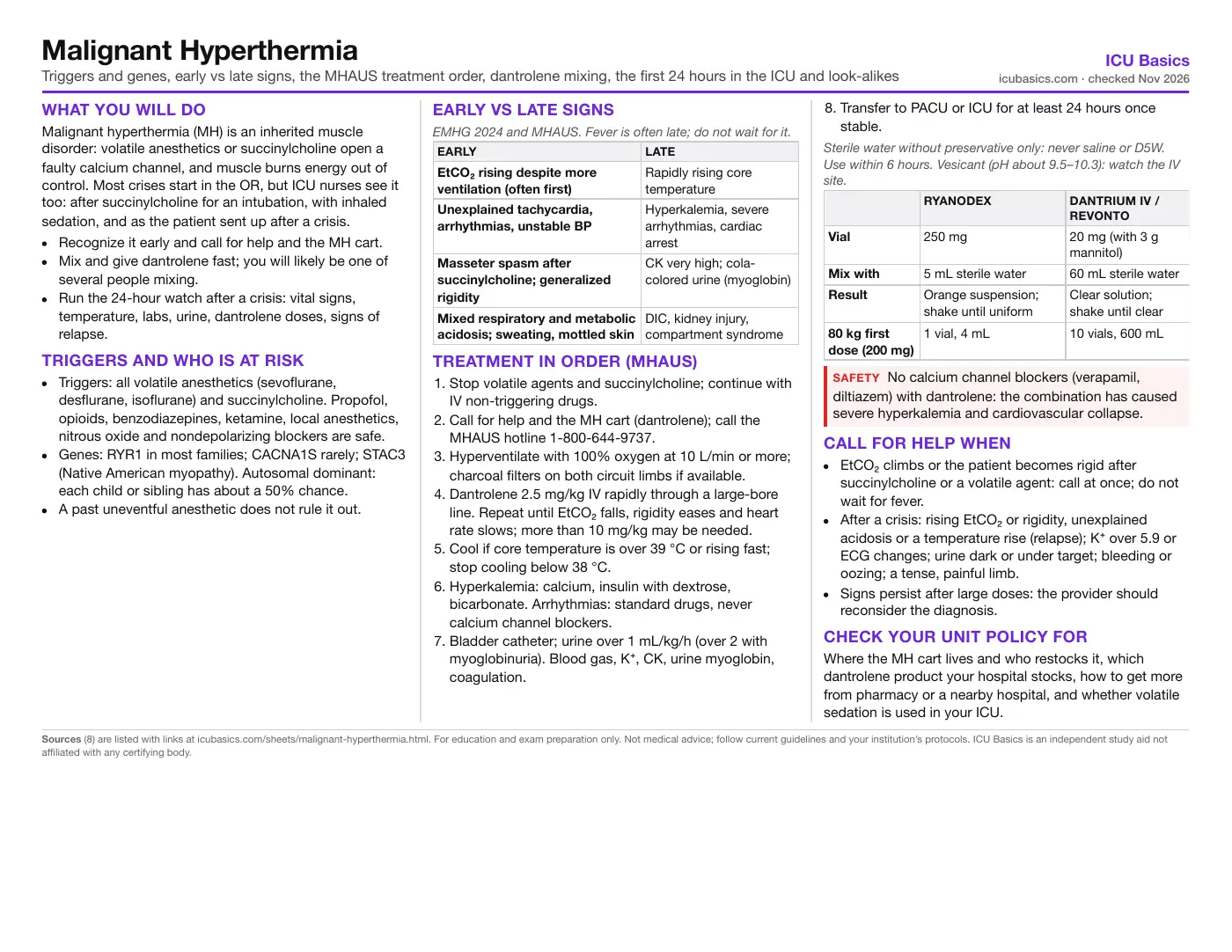
Malignant hyperthermia (MH) is an inherited muscle disorder: volatile anesthetics or succinylcholine open a faulty calcium channel, and muscle burns energy out of control. Most crises start in the OR, but ICU nurses see it too: after succinylcholine for an intubation, with inhaled sedation, and as the patient sent up after a crisis.
- Recognize it early and call for help and the MH cart.
- Mix and give dantrolene fast; you will likely be one of several people mixing.
- Run the 24-hour watch after a crisis: vital signs, temperature, labs, urine, dantrolene doses, signs of relapse.
Triggers and who is at risk
- Triggers: all volatile anesthetics (sevoflurane, desflurane, isoflurane) and succinylcholine. Propofol, opioids, benzodiazepines, ketamine, local anesthetics, nitrous oxide and nondepolarizing blockers are safe.
- Genes: RYR1 in most families; CACNA1S rarely; STAC3 (Native American myopathy). Autosomal dominant: each child or sibling has about a 50% chance.
- A past uneventful anesthetic does not rule it out.
Early vs late signs
| Early | Late |
|---|---|
| EtCO₂ rising despite more ventilation (often first) | Rapidly rising core temperature |
| Unexplained tachycardia, arrhythmias, unstable BP | Hyperkalemia, severe arrhythmias, cardiac arrest |
| Masseter spasm after succinylcholine; generalized rigidity | CK very high; cola-colored urine (myoglobin) |
| Mixed respiratory and metabolic acidosis; sweating, mottled skin | DIC, kidney injury, compartment syndrome |
Treatment in order (MHAUS)
- Stop volatile agents and succinylcholine; continue with IV non-triggering drugs.
- Call for help and the MH cart (dantrolene); call the MHAUS hotline 1-800-644-9737.
- Hyperventilate with 100% oxygen at 10 L/min or more; charcoal filters on both circuit limbs if available.
- Dantrolene 2.5 mg/kg IV rapidly through a large-bore line. Repeat until EtCO₂ falls, rigidity eases and heart rate slows; more than 10 mg/kg may be needed.
- Cool if core temperature is over 39 °C or rising fast; stop cooling below 38 °C.
- Hyperkalemia: calcium, insulin with dextrose, bicarbonate. Arrhythmias: standard drugs, never calcium channel blockers.
- Bladder catheter; urine over 1 mL/kg/h (over 2 with myoglobinuria). Blood gas, K⁺, CK, urine myoglobin, coagulation.
- Transfer to PACU or ICU for at least 24 hours once stable.
| Ryanodex | Dantrium IV / Revonto | |
|---|---|---|
| Vial | 250 mg | 20 mg (with 3 g mannitol) |
| Mix with | 5 mL sterile water | 60 mL sterile water |
| Result | Orange suspension; shake until uniform | Clear solution; shake until clear |
| 80 kg first dose (200 mg) | 1 vial, 4 mL | 10 vials, 600 mL |
Call for help when
- EtCO₂ climbs or the patient becomes rigid after succinylcholine or a volatile agent: call at once; do not wait for fever.
- After a crisis: rising EtCO₂ or rigidity, unexplained acidosis or a temperature rise (relapse); K⁺ over 5.9 or ECG changes; urine dark or under target; bleeding or oozing; a tense, painful limb.
- Signs persist after large doses: the provider should reconsider the diagnosis.
Check your unit policy for
Where the MH cart lives and who restocks it, which dantrolene product your hospital stocks, how to get more from pharmacy or a nearby hospital, and whether volatile sedation is used in your ICU.
In depth
The one-page summary above is what the PDF prints. These sections go further.
What goes wrong in the muscle
In susceptible muscle, the ryanodine receptor (RYR1) releases too much calcium from the sarcoplasmic reticulum when exposed to a trigger. The muscle contracts, burns ATP and oxygen, and makes CO₂, lactate and heat. As cells fail, potassium, CK and myoglobin leak out. Dantrolene works inside the muscle by reducing this calcium release; it does not act at the neuromuscular junction.
Crises occur in about 1 in 10,000 to 1 in 250,000 anesthetics, but the genetic change may be present in as many as 1 in 400 people (Rosenberg 2015). Mortality has fallen from about 80% to under 5% with dantrolene, capnography and core temperature monitoring. More than 400 RYR1 variants are known; CACNA1S accounts for under 1%, and a STAC3 variant causes Native American myopathy with MH susceptibility.
Dantrolene in practice
- Dose by actual body weight. MHAUS: 2.5 mg/kg, repeated as needed. EMHG: 2–2.5 mg/kg (up to 300 mg per dose) every 10 minutes until EtCO₂ and temperature fall; an adult may need up to 1,200 mg.
- The labels start at 1 mg/kg and name a maximum cumulative dose of 10 mg/kg. MHAUS and EMHG say more may be needed if dantrolene is still working; if large doses do nothing, think of another diagnosis.
- Dantrium and Revonto: each 20 mg vial takes 60 mL of sterile water and carries 3 g of mannitol. Assign several people to mix, and count the mannitol if more is ordered for the kidneys. Large diluent volumes have been linked to pulmonary edema.
- Ryanodex: 250 mg in 5 mL, given as an IV push. Do not dilute it or transfer it to another container. Its mannitol content is too small to keep up diuresis.
- Side effects: muscle weakness (watch breathing and swallowing after extubation), drowsiness, phlebitis; extravasation can cause tissue necrosis.
The ICU phase: the first 24 hours and beyond
- Continuous HR, ECG, RR, SpO₂, EtCO₂ if intubated, core temperature and muscle tone; strict urine output. Arterial line and central line as the provider decides.
- Dantrolene 1 mg/kg IV every 4–6 hours for at least 24 hours (MHAUS). MHAUS found no evidence that a continuous infusion is better than boluses; use an infusion only if ordered.
- Labs per MHAUS: K⁺, blood gas and lactate every 8 hours; CK every 8 hours until falling; creatinine at least daily if myoglobinuria; coagulation at baseline and with any bleeding. CK over 10,000 IU/L means rhabdomyolysis until shown otherwise.
- Myoglobinuria: urine over 2 mL/kg/h with fluids and diuretics; bicarbonate to alkalinize the urine per order.
- Dantrolene can stop, or the interval stretch to every 8–12 hours, only when all are true: metabolically stable for 24 hours, core temperature under 38 °C, CK falling, no myoglobinuria, no rigidity.
Hyperkalemia and acidosis doses (MHAUS, adult)
| Problem | Treatment |
|---|---|
| K⁺ over 5.9 mEq/L (5.9 mmol/L) or ECG changes | Calcium chloride 10 mg/kg (max 2,000 mg) or calcium gluconate 10–50 mg/kg (max 3,000 mg) |
| Shift potassium | Regular insulin 10 units IV with 50 mL of 50% dextrose; glucose hourly |
| Metabolic acidosis (base deficit over 8) | Sodium bicarbonate 1–2 mEq/kg IV |
| Refractory hyperkalemia | Albuterol, dialysis; ECMO if in arrest |
Look-alikes
| Condition | Clue | How it differs from MH |
|---|---|---|
| Neuroleptic malignant syndrome | Antipsychotic or stopped levodopa | Develops over days; lead-pipe rigidity, confusion |
| Serotonin syndrome | Serotonergic drugs | Hours; clonus and hyperreflexia, diarrhea |
| Thyroid storm | Thyroid history, surgery or stress | No rigidity; high T4, low TSH |
| Sepsis | Infection source | Gradual; no rigidity; EtCO₂ rarely climbs fast |
| High EtCO₂ from the setup | Laparoscopy, low fresh gas flow | No rigidity; resolves with more ventilation |
After the crisis: the patient and family
- The patient and blood relatives are treated as MH-susceptible until tested. Refer to an MH diagnostic center; after a fulminant episode MHAUS advises sequencing the whole RYR1 gene.
- Report the event to the North American MH Registry (AMRA form, MHAUS).
- Document it clearly as an allergy-style alert, and tell the patient to inform every future anesthesia team; a medical alert ID helps.
- Future anesthetics use a vapor-free (flushed or filtered) machine and non-triggering drugs.
- MH can be linked to exertional heat stroke and exercise rhabdomyolysis in some RYR1 carriers; Rosenberg suggests excluding MH after exertional heat stroke.
Exam pearls
- First sign under anesthesia: EtCO₂ rising despite more ventilation, with tachycardia. Fever comes late.
- Masseter spasm after succinylcholine is a warning sign.
- First drug: dantrolene 2.5 mg/kg IV; first action: stop the trigger and call for help.
- Never give a calcium channel blocker with dantrolene.
- Watch at least 24 hours in the ICU for relapse.
Related cheat sheets
- Neuro: ICP and StrokeICP, herniation, EVD care, osmotics, GCS, stroke and seizures
- Brain Bleeds by Type, and Craniotomy vs Craniectomy CareEpidural, subdural, subarachnoid, intracerebral and diffuse axonal injury; reversal, BP targets and post-op care
- Subarachnoid HemorrhageAneurysmal SAH: diagnosis, grading, rebleeding, nimodipine, vasospasm and DCI, sodium and nursing care
- Meningitis and EncephalitisFirst-hour care, empiric antibiotics, dexamethasone, CT before LP, CSF patterns, HSV and autoimmune encephalitis, isolation and ICU complications
- Myasthenic Crisis and Guillain-Barré SyndromeNeuromuscular respiratory failure, NIV or intubation, IVIG and plasma exchange, crisis drugs and ICU care
- Sedation, Pain and Delirium ScalesRASS, CPOT, BPS, CAM-ICU, ICDSC, SAT/SBT, and PADIS 2018 with the 2025 update
Calculators for this topic
Sources
- Malignant Hyperthermia Association of the United States (MHAUS). Managing a Crisis: emergency therapy for MH. Accessed November 2026. Link
- MHAUS. After a Crisis: Post-Acute Phase. Accessed November 2026. Link
- MHAUS Professional Advisory Council. Dantrolene administration after an MH event (2017 recommendation). Link
- Glahn KPE, Girard T, Hellblom A, et al; European Malignant Hyperthermia Group. Recognition and management of a malignant hyperthermia crisis: updated 2024 guideline from the EMHG. Br J Anaesth. 2025;134:221–223 (EMHG website version). Link
- Rosenberg H, Pollock N, Schiemann A, Bulger T, Stowell K. Malignant hyperthermia: a review. Orphanet J Rare Dis. 2015;10:93. Link
- Ryanodex (dantrolene sodium) for injectable suspension, prescribing information. Eagle Pharmaceuticals; DailyMed, November 2024. Link
- Revonto (dantrolene sodium) for injection, prescribing information. DailyMed, December 2025. Link
- Dantrium Intravenous (dantrolene sodium for injection), prescribing information. Par Health; DailyMed, April 2026. Link