 ICU Basics
Cheat Sheet
Organ Donation and the ICU Nurse
Timely OPO referral, who asks the family, brain death and DCD in brief, donor management goals, family support and charting
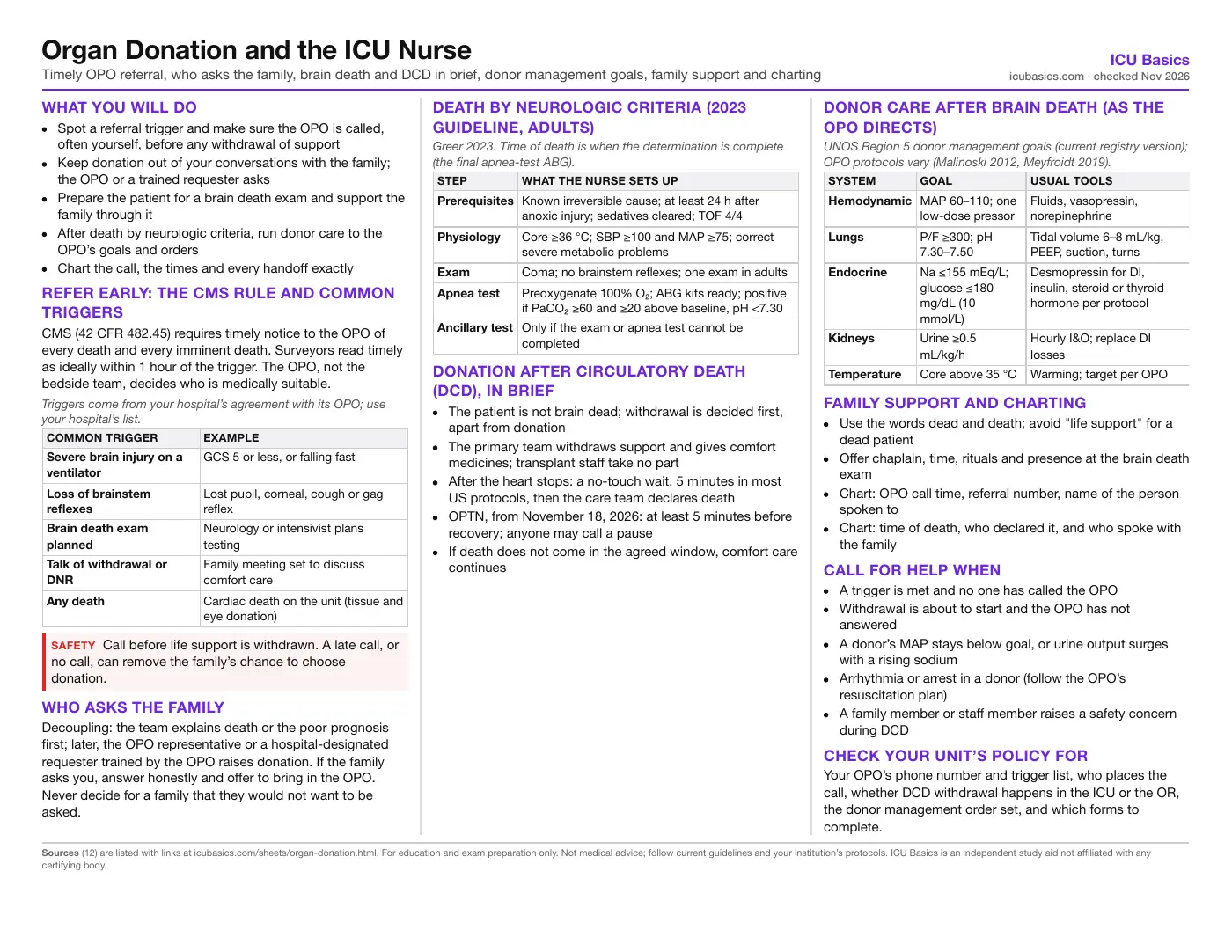
What you will do
- Spot a referral trigger and make sure the OPO is called, often yourself, before any withdrawal of support
- Keep donation out of your conversations with the family; the OPO or a trained requester asks
- Prepare the patient for a brain death exam and support the family through it
- After death by neurologic criteria, run donor care to the OPO’s goals and orders
- Chart the call, the times and every handoff exactly
Refer early: the CMS rule and common triggers
CMS (42 CFR 482.45) requires timely notice to the OPO of every death and every imminent death. Surveyors read timely as ideally within 1 hour of the trigger. The OPO, not the bedside team, decides who is medically suitable.
| Common trigger | Example |
|---|---|
| Severe brain injury on a ventilator | GCS 5 or less, or falling fast |
| Loss of brainstem reflexes | Lost pupil, corneal, cough or gag reflex |
| Brain death exam planned | Neurology or intensivist plans testing |
| Talk of withdrawal or DNR | Family meeting set to discuss comfort care |
| Any death | Cardiac death on the unit (tissue and eye donation) |
Who asks the family
Decoupling: the team explains death or the poor prognosis first; later, the OPO representative or a hospital-designated requester trained by the OPO raises donation. If the family asks you, answer honestly and offer to bring in the OPO. Never decide for a family that they would not want to be asked.
Death by neurologic criteria (2023 guideline, adults)
| Step | What the nurse sets up |
|---|---|
| Prerequisites | Known irreversible cause; at least 24 h after anoxic injury; sedatives cleared; TOF 4/4 |
| Physiology | Core ≥36 °C; SBP ≥100 and MAP ≥75; correct severe metabolic problems |
| Exam | Coma; no brainstem reflexes; one exam in adults |
| Apnea test | Preoxygenate 100% O₂; ABG kits ready; positive if PaCO₂ ≥60 and ≥20 above baseline, pH <7.30 |
| Ancillary test | Only if the exam or apnea test cannot be completed |
Donation after circulatory death (DCD), in brief
- The patient is not brain dead; withdrawal is decided first, apart from donation
- The primary team withdraws support and gives comfort medicines; transplant staff take no part
- After the heart stops: a no-touch wait, 5 minutes in most US protocols, then the care team declares death
- OPTN, from November 18, 2026: at least 5 minutes before recovery; anyone may call a pause
- If death does not come in the agreed window, comfort care continues
Donor care after brain death (as the OPO directs)
| System | Goal | Usual tools |
|---|---|---|
| Hemodynamic | MAP 60–110; one low-dose pressor | Fluids, vasopressin, norepinephrine |
| Lungs | P/F ≥300; pH 7.30–7.50 | Tidal volume 6–8 mL/kg, PEEP, suction, turns |
| Endocrine | Na ≤155 mEq/L; glucose ≤180 mg/dL (10 mmol/L) | Desmopressin for DI, insulin, steroid or thyroid hormone per protocol |
| Kidneys | Urine ≥0.5 mL/kg/h | Hourly I&O; replace DI losses |
| Temperature | Core above 35 °C | Warming; target per OPO |
Family support and charting
- Use the words dead and death; avoid "life support" for a dead patient
- Offer chaplain, time, rituals and presence at the brain death exam
- Chart: OPO call time, referral number, name of the person spoken to
- Chart: time of death, who declared it, and who spoke with the family
Call for help when
- A trigger is met and no one has called the OPO
- Withdrawal is about to start and the OPO has not answered
- A donor’s MAP stays below goal, or urine output surges with a rising sodium
- Arrhythmia or arrest in a donor (follow the OPO’s resuscitation plan)
- A family member or staff member raises a safety concern during DCD
Check your unit’s policy for
Your OPO’s phone number and trigger list, who places the call, whether DCD withdrawal happens in the ICU or the OR, the donor management order set, and which forms to complete.
In depth
The one-page summary above is what the PDF prints. These sections go further.
Referral: the rule, the timing and why it matters
Under 42 CFR 482.45, every hospital must have a written agreement with its designated organ procurement organization (OPO) and must notify it, in a timely manner, of individuals whose death is imminent or who have died. The OPO, not the hospital, decides medical suitability. CMS interpretive guidance (State Operations Manual tags A-0886 to A-0891) reads timely as ideally within 1 hour of a patient meeting the hospital’s criteria and before life-sustaining therapy is withdrawn, and it does not allow batch lists of deaths sent later.
Each hospital writes its imminent-death triggers with its OPO. Common examples are a ventilated patient with a severe brain injury and a GCS at or below an agreed number (often 5), the loss of one or more brainstem reflexes, a planned brain death evaluation, and any discussion of withdrawal of support or a DNR order in such a patient. These are clinical triggers, so they do not wait for a family request or a physician order. Some hospitals let any nurse place the call; others route it through the charge nurse. Know which applies before you need it.
Early referral gives the OPO time to review the chart and judge suitability before the family is approached, and it protects the family’s option to donate. Tissue and eye donation are possible after almost any death, which is why every cardiac death is referred too.
Decoupling and the request
CMS lets only an OPO representative or a designated requester, someone who has completed an OPO-approved course, start the donation request. The care team’s job is to explain the injury, the prognosis or the death in its own conversation. Separating that talk from the request, in time and by person, is called decoupling. It keeps care decisions about the patient alone and gives the family time to understand that death has occurred, or that withdrawal is planned, before they are asked to decide anything else.
The 2023 brain death guideline asks clinicians to decide only in their patient’s interest, and the ATS/ISHLT/SCCM/AOPO/UNOS statement on DCD (Gries 2013) places the decision to withdraw before any mention of donation and gives transplant staff no role in that decision, the withdrawal or the declaration of death. In most states a registered adult donor’s own gift stands under the revised Uniform Anatomical Gift Act; the OPO then informs the family rather than asking.
- If the family raises donation first: "That is an important question. Let me bring in the person who can answer it fully."
- Do not guess at a family’s answer from their grief, faith, culture or income; CMS bars skipping anyone on those grounds.
- Plan the OPO’s approach together in a short huddle: who is present, what the family already understands, and the setting.
Brain death testing: the nurse’s setup
The 2023 AAN/AAP/CNS/SCCM guideline (Greer 2023) is the current US standard. Before the exam, the cause must be known and irreversible, enough time must have passed (at least 24 hours after an anoxic injury), and confounders must be cleared: sedatives after about five half-lives or by level, a train-of-four with four twitches, and no severe metabolic or endocrine disturbance that could explain the coma. Adults need a core temperature of at least 36 °C and both an SBP of at least 100 and a MAP of at least 75 (MAP alone on VA-ECMO). The nurse warms the patient, titrates pressors to those targets and confirms the drug history.
One examination is enough in adults; children need two, 12 hours apart. The examiner looks for coma and the absence of pupillary, corneal, oculocephalic, oculovestibular (cold caloric), gag and cough reflexes and of any response to pain within the cranial nerve territory. Spinal reflexes can persist and should be explained to the family ahead of time.
For the apnea test, bring PaCO₂ to 35–45 mm Hg, preoxygenate with 100% oxygen for at least 10 minutes, then stop ventilator breaths and give oxygen through a catheter at the carina (4–6 L/min in adults), CPAP or a resuscitation bag. The test is positive when no breaths occur and PaCO₂ is at least 60 mm Hg and at least 20 above baseline with an arterial pH below 7.30. Stop and reconnect if SBP falls below 100 or MAP below 75, SpO₂ falls progressively below 85%, or an unstable arrhythmia appears. Have ABG syringes labeled and a runner ready so results return fast.
Ancillary tests (catheter angiography, radionuclide flow study, or transcranial Doppler in adults) are needed only when the exam or apnea test cannot be completed. EEG, CTA, MRA and MRI do not count. Time of death is when the determination is complete: the final apnea-test ABG result, or the ancillary test result. Testing needs no consent unless state law or hospital policy requires it, but the family should be told it is happening and may be offered a place at the bedside.
DCD at the bedside
Controlled DCD is possible when a patient who is not brain dead has a planned withdrawal of life support. The family decides about withdrawal first; the OPO then raises donation. The OPO arranges recovery teams and gives the window during which death must occur for organs to be usable. Withdrawal may happen in the ICU or in or near the OR, depending on hospital policy. Premortem drugs such as heparin, and any premortem procedure, need specific consent; OPTN rules from November 18, 2026 make that consent explicit.
The primary ICU team leads withdrawal and comfort care exactly as it would for any dying patient, dosing opioids and sedatives to symptoms, never to hasten death. After circulation stops (usually confirmed by arterial line pulse pressure), a no-touch period follows. Gries 2013 accepts at least 2 minutes before declaration; most US protocols wait 5, and the OPTN policy now requires at least 5 minutes from circulatory cessation before organ recovery begins. Any autoresuscitation is reported. A member of the care team, never the transplant team, declares death.
Under the same OPTN changes, anyone, including the family or the bedside nurse, may call an unplanned DCD pause if a safety concern arises, and donor hospitals document neurologic assessments so any discrepancy with OPO observations is escalated. If death does not come within the window, donation is called off and the patient returns to comfort care, often on the ICU. Prepare the family for this possibility before withdrawal starts.
Donor management after brain death
Brain death sets off a catecholamine surge, then vasoplegia, central diabetes insipidus and loss of temperature control (Meyfroidt 2019). After declaration the OPO coordinator takes charge of donor goals and writes or approves orders; the ICU nurse carries them out, often hourly. Meeting the UNOS Region 5 donor management goals (any 7 of 9) before recovery predicted more organs transplanted per donor (Malinoski 2012).
| Goal | Target |
|---|---|
| MAP | 60–110 mm Hg |
| CVP | 4–12 mm Hg |
| Ejection fraction | 50% or higher |
| Vasopressors | One, low dose (norepinephrine ≤0.2 mcg/kg/min) |
| Arterial pH | 7.30–7.50 |
| PaO₂/FiO₂ | 300 or higher |
| Sodium | 155 mEq/L (155 mmol/L) or lower |
| Glucose | 180 mg/dL (10 mmol/L) or lower |
| Urine output | 0.5 mL/kg/h or more over 4 h |
Hemodynamics: the Canadian guideline (Ball 2020) suggests a MAP of at least 65, vasopressin as the first vasopressor and norepinephrine second, and suggests against dopamine. Vasopressin also treats diabetes insipidus. Diabetes insipidus shows as large volumes of dilute urine with a rising sodium: replace free water and give desmopressin 1–4 mcg IV as ordered, or vasopressin when hypotension coexists (Meyfroidt 2019).
Lungs: lung-protective ventilation (tidal volume 6–8 mL/kg, PEEP of at least 8, recruitment after disconnections; Ball 2020), suction, turns and bronchoscopy when the OPO requests it. Endocrine: insulin to keep glucose at or below 180; methylprednisolone is still common, given after HLA blood is drawn. Older consensus (Kotloff 2015) supported thyroid hormone for unstable donors, but in Dhar 2023 (838 unstable heart donors) levothyroxine 30 mcg/h did not add hearts transplanted and caused more hypertension and tachycardia, so use it only when the OPO protocol calls for it. Temperature: keep the core above 35 °C; some OPOs target 34–35 °C to protect the kidneys.
Supporting the family and the team
Families of brain-dead patients often struggle because the chest still rises and the monitor still shows a rhythm. Use plain words: "Your mother has died. The machine is moving air and medicines keep her heart beating." Avoid "life support" for a patient who has died. Offer the chance to be present for the exam, to hold hands, to bring in faith leaders and to keep rituals, and keep the room calm and private while donor care goes on around them.
Donor care can last a day or more. Cluster tasks, keep the family updated on timing, and tell them when the patient will leave for the OR. After recovery, the OPO usually offers the family follow-up letters about outcomes. Staff can feel moral distress caring for a donor; a short debrief after the case helps, and any nurse who objects to taking part should hand off care rather than leave the patient or family.
Documentation and timing
- Referral: the trigger met, the time it was met, the time of the OPO call, the referral or reference number, and the OPO staff member’s name.
- Family: who explained the injury or death, when, and who (OPO or designated requester) discussed donation; document the decision as the OPO reports it.
- Brain death: each exam step, apnea-test ABG times and values, the physician who determined death, and the legal time of death.
- DCD: withdrawal start time, medicines given with the symptom they treated, time circulation stopped, no-touch period, time of death and who declared it, and any pause called.
- Donor care: hourly vital signs, urine output, drips and labs against the OPO goals, and the time the patient left for the OR.
Related cheat sheets
- Neuro: ICP and StrokeICP, herniation, EVD care, osmotics, GCS, stroke and seizures
- Brain Bleeds by Type, and Craniotomy vs Craniectomy CareEpidural, subdural, subarachnoid, intracerebral and diffuse axonal injury; reversal, BP targets and post-op care
- Subarachnoid HemorrhageAneurysmal SAH: diagnosis, grading, rebleeding, nimodipine, vasospasm and DCI, sodium and nursing care
- Meningitis and EncephalitisFirst-hour care, empiric antibiotics, dexamethasone, CT before LP, CSF patterns, HSV and autoimmune encephalitis, isolation and ICU complications
- Myasthenic Crisis and Guillain-Barré SyndromeNeuromuscular respiratory failure, NIV or intubation, IVIG and plasma exchange, crisis drugs and ICU care
- Sedation, Pain and Delirium ScalesRASS, CPOT, BPS, CAM-ICU, ICDSC, SAT/SBT, and PADIS 2018 with the 2025 update
Calculators for this topic
Sources
- Code of Federal Regulations. 42 CFR 482.45: Condition of participation: Organ, tissue, and eye procurement. Link
- Centers for Medicare & Medicaid Services. State Operations Manual, Appendix A: Survey Protocol, Regulations and Interpretive Guidelines for Hospitals; tags A-0886 to A-0891 (organ, tissue and eye procurement). Link
- Greer DM, Kirschen MP, Lewis A, et al. Pediatric and Adult Brain Death/Death by Neurologic Criteria Consensus Guideline: Report of the AAN Guidelines Subcommittee, AAP, CNS, and SCCM. Neurology. 2023;101(24):1112-1132. Link
- Lewis A, Kirschen MP, Greer D. The 2023 AAN/AAP/CNS/SCCM Pediatric and Adult Brain Death/Death by Neurologic Criteria Consensus Practice Guideline: A Comparison With the 2010 and 2011 Guidelines. Neurol Clin Pract. 2023;13(6):e200189. Link
- Health Resources and Services Administration. Upcoming Donation after Circulatory Death Policy Changes (OPTN policy, implementation November 18, 2026). HRSA bulletin, September 18, 2026. Link
- Gries CJ, White DB, Truog RD, et al. An official ATS/ISHLT/SCCM/AOPO/UNOS statement: ethical and policy considerations in organ donation after circulatory determination of death. Am J Respir Crit Care Med. 2013;188(1):103-109. Link
- Kotloff RM, Blosser S, Fulda GJ, et al. Management of the Potential Organ Donor in the ICU: Society of Critical Care Medicine/American College of Chest Physicians/Association of Organ Procurement Organizations Consensus Statement. Crit Care Med. 2015;43(6):1291-1325. Link
- Malinoski DJ, Patel MS, Daly MC, et al. The impact of meeting donor management goals on the number of organs transplanted per donor: results from the UNOS Region 5 prospective donor management goals study. Crit Care Med. 2012;40(10):2773-2780. Link
- Meyfroidt G, Gunst J, Martin-Loeches I, et al. Management of the brain-dead donor in the ICU: general and specific therapy to improve transplantable organ quality. Intensive Care Med. 2019;45(3):343-353. Link
- Ball IM, Hornby L, Rochwerg B, et al. Management of the neurologically deceased organ donor: A Canadian clinical practice guideline. CMAJ. 2020;192(14):E361-E369. Link
- Dhar R, Marklin GF, Klinkenberg WD, et al. Intravenous Levothyroxine for Unstable Brain-Dead Heart Donors. N Engl J Med. 2023;389(22):2029-2038. Link
- Organ Donation and Transplantation Alliance (formerly the Organ Donation Breakthrough Collaborative). Donor management resources. Link