 ICU Basics
Cheat Sheet
Paralytics and Train-of-Four Monitoring
When ICU patients are paralyzed, sedation first, the three infusions, how to do a train-of-four, bedside care and stopping
Practice 16 Paralytics and Train-of-Four Monitoring questions
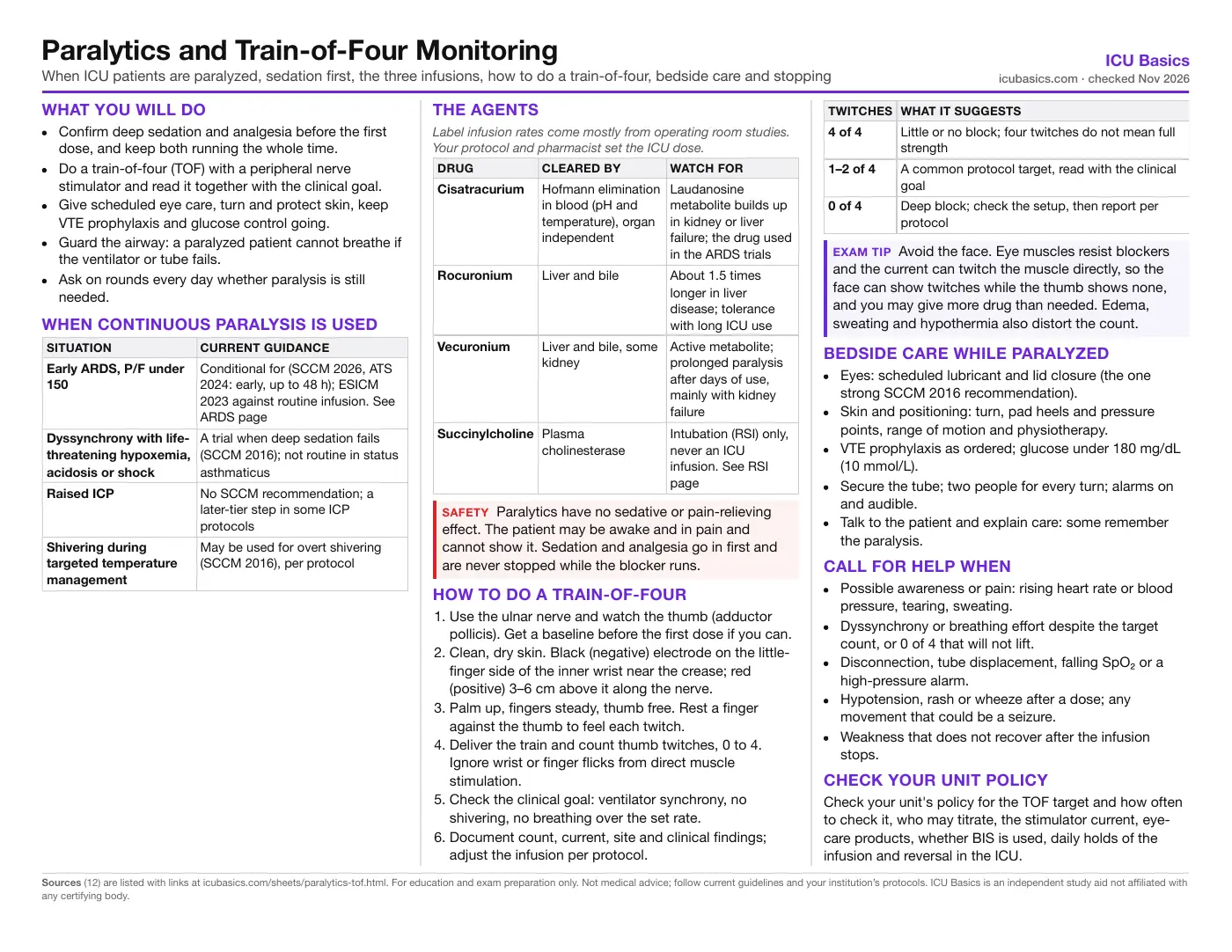
What you will do
- Confirm deep sedation and analgesia before the first dose, and keep both running the whole time.
- Do a train-of-four (TOF) with a peripheral nerve stimulator and read it together with the clinical goal.
- Give scheduled eye care, turn and protect skin, keep VTE prophylaxis and glucose control going.
- Guard the airway: a paralyzed patient cannot breathe if the ventilator or tube fails.
- Ask on rounds every day whether paralysis is still needed.
When continuous paralysis is used
| Situation | Current guidance |
|---|---|
| Early ARDS, P/F under 150 | Conditional for (SCCM 2026, ATS 2024: early, up to 48 h); ESICM 2023 against routine infusion. See ARDS page |
| Dyssynchrony with life-threatening hypoxemia, acidosis or shock | A trial when deep sedation fails (SCCM 2016); not routine in status asthmaticus |
| Raised ICP | No SCCM recommendation; a later-tier step in some ICP protocols |
| Shivering during targeted temperature management | May be used for overt shivering (SCCM 2016), per protocol |
The agents
| Drug | Cleared by | Watch for |
|---|---|---|
| Cisatracurium | Hofmann elimination in blood (pH and temperature), organ independent | Laudanosine metabolite builds up in kidney or liver failure; the drug used in the ARDS trials |
| Rocuronium | Liver and bile | About 1.5 times longer in liver disease; tolerance with long ICU use |
| Vecuronium | Liver and bile, some kidney | Active metabolite; prolonged paralysis after days of use, mainly with kidney failure |
| Succinylcholine | Plasma cholinesterase | Intubation (RSI) only, never an ICU infusion. See RSI page |
How to do a train-of-four
- Use the ulnar nerve and watch the thumb (adductor pollicis). Get a baseline before the first dose if you can.
- Clean, dry skin. Black (negative) electrode on the little-finger side of the inner wrist near the crease; red (positive) 3–6 cm above it along the nerve.
- Palm up, fingers steady, thumb free. Rest a finger against the thumb to feel each twitch.
- Deliver the train and count thumb twitches, 0 to 4. Ignore wrist or finger flicks from direct muscle stimulation.
- Check the clinical goal: ventilator synchrony, no shivering, no breathing over the set rate.
- Document count, current, site and clinical findings; adjust the infusion per protocol.
| Twitches | What it suggests |
|---|---|
| 4 of 4 | Little or no block; four twitches do not mean full strength |
| 1–2 of 4 | A common protocol target, read with the clinical goal |
| 0 of 4 | Deep block; check the setup, then report per protocol |
Bedside care while paralyzed
- Eyes: scheduled lubricant and lid closure (the one strong SCCM 2016 recommendation).
- Skin and positioning: turn, pad heels and pressure points, range of motion and physiotherapy.
- VTE prophylaxis as ordered; glucose under 180 mg/dL (10 mmol/L).
- Secure the tube; two people for every turn; alarms on and audible.
- Talk to the patient and explain care: some remember the paralysis.
Call for help when
- Possible awareness or pain: rising heart rate or blood pressure, tearing, sweating.
- Dyssynchrony or breathing effort despite the target count, or 0 of 4 that will not lift.
- Disconnection, tube displacement, falling SpO₂ or a high-pressure alarm.
- Hypotension, rash or wheeze after a dose; any movement that could be a seizure.
- Weakness that does not recover after the infusion stops.
Check your unit policy
Check your unit's policy for the TOF target and how often to check it, who may titrate, the stimulator current, eye-care products, whether BIS is used, daily holds of the infusion and reversal in the ICU.
In depth
The one-page summary above is what the PDF prints. These sections go further.
Why paralyze, and what the trials showed
A neuromuscular blocker stops the patient fighting the ventilator, removes large spontaneous breaths and shivering, and lowers oxygen use. In ARDS, ACURASYS (Papazian 2010; 340 patients, P/F under 150 within 48 h) gave cisatracurium for 48 h against placebo with deep sedation in both arms: adjusted 90-day hazard ratio for death 0.68, crude mortality 31.6% vs 40.7%, and no difference in ICU-acquired paresis. ROSE (Moss 2019; 1,006 patients) used the same fixed dose, a 15 mg bolus then 37.5 mg/h for 48 h, against usual care with light sedation and was stopped for futility: 90-day mortality 42.5% vs 42.8%, with less physical activity and more cardiovascular events in the paralyzed group.
The comparator explains much of the difference (see the ARDS page). The 2026 SCCM ARDS guideline makes a conditional recommendation for neuromuscular blockade at P/F under 150 and finds equipoise on titrated versus fixed dosing, on a monitoring-based strategy for sedation depth, and on paralysis during proning. SCCM 2016 suggests against routine blockade in ventilated status asthmaticus but supports a trial in life-threatening hypoxemia, respiratory acidosis or hemodynamic compromise when deep sedation fails. It makes no recommendation for raised ICP or for routine use after cardiac arrest, and suggests blockers may be used for overt shivering during temperature management (see Post-Arrest Care).
Pharmacology and organ failure
All three ICU agents are nondepolarizing: they compete with acetylcholine at the nicotinic receptor. Cisatracurium (a benzylisoquinolinium) breaks down mainly by Hofmann elimination, a chemical process that depends on pH and temperature, so liver and kidney failure barely change its clearance. Its metabolite laudanosine causes seizures in animals, and the label warns that metabolite levels run higher with renal or hepatic impairment during long infusions. The label ICU infusion rate is 3 mcg/kg/min (range 0.5 to 10.2) after recovery from the bolus.
Rocuronium and vecuronium are aminosteroids cleared mainly by the liver and bile. The rocuronium label reports a clinical duration about 1.5 times longer in hepatic disease, says the drug has not been studied for long-term ICU use, and warns of apparent tolerance during chronic administration. Vecuronium has an active metabolite, 3-desacetylvecuronium. In Segredo 1992, 7 of 16 ICU patients given vecuronium for more than two days stayed paralyzed for six hours to more than seven days after it stopped; all seven had renal failure, with higher metabolite levels, acidosis and higher magnesium.
Block is deepened by aminoglycosides, magnesium, lithium, diuretics, antiarrhythmics, low potassium, hypothermia and acidosis, and by myasthenia gravis. Burn patients are resistant. In obesity SCCM 2016 suggests dosing on a consistent weight (ideal or adjusted), not actual body weight.
Train-of-four in depth
The stimulator gives four pulses half a second apart. As block deepens the fourth twitch disappears first, then the third, second and first; on recovery they return in reverse. Four twitches do not mean full strength: recovery for extubation is a TOF ratio (fourth twitch over first) of 0.9, and by eye or touch nobody can detect fade once the ratio is above about 0.4. That is why a count of 4 never proves the block is gone.
Muscles differ. The diaphragm and eye muscles need more drug than the thumb and recover sooner, so a patient can cough or breathe at 0 of 4 at the thumb, and the face can twitch while the thumb is silent. In one SCCM-cited case a hypothermic patient stayed dyssynchronous at 0 of 4 until rewarmed. In edema, palpate the ulnar artery or use ultrasound to find the ulnar nerve, which runs beside it.
SCCM 2016 suggests TOF can be useful only as part of a wider clinical assessment and suggests against TOF alone. It sets no twitch target; many unit protocols aim for 1 to 2 of 4 while the clinical goal is met. The ARDS trials did not titrate to the stimulator at all, and SCCM 2026 found equipoise between titrated and fixed dosing.
Sedation, awareness and BIS
SCCM 2016 makes it a good practice statement to give analgesics and sedatives before and during blockade, aiming for deep sedation, and says they should not be stopped while the blocker runs. Heart rate, blood pressure, sweating and tearing are the only cues and are unreliable. Patients paralyzed without enough sedation describe terror and panic; propofol alone and low benzodiazepine doses were linked to recall in one series. In ROSE, recall of paralysis was 1.8% vs 2.0%. Frequent verbal reassurance helps.
Processed EEG (BIS and similar) is used in some units, but SCCM 2016 made no recommendation: values overlap across sedation levels, and blockers themselves lower the number because muscle activity feeds into it. SCCM 2026 found equipoise on a monitoring-based strategy. A paralyzed patient also cannot show a seizure; continuous EEG is needed when one is suspected.
Complications and how to prevent them
| Complication | Prevention or response |
|---|---|
| ICU-acquired weakness | Shortest course; avoid needless steroids with blockers; physiotherapy; glucose under 180 mg/dL |
| Prolonged paralysis | Stimulator monitoring; extra caution with vecuronium in kidney failure |
| Corneal injury (20–60% of deeply sedated or paralyzed) | Scheduled lubricant and lid closure from the start |
| Pressure injury, VTE | Turning, padding, prophylaxis as ordered |
| Unplanned extubation | Secure tube, controlled turns; risk rises as the block wears off |
| Awareness | Deep sedation and analgesia throughout; reassurance |
SCCM 2016 recommends stopping blockers before brain death testing and suggests stopping them at the end of life or when life support is withdrawn.
Stopping and reversal
Stopping the infusion on a schedule lets the team check whether sedation and analgesia are adequate and whether paralysis is still needed. Most ICU patients recover spontaneously; SCCM 2016 notes reversal is common in the operating room but rare in the ICU. After the blocker is off, return to light sedation and the daily awakening and breathing trials (see Sedation Scales).
- Sugammadex reverses rocuronium or vecuronium only (not cisatracurium). Label: 2 mg/kg once the second twitch returns, 4 mg/kg at 1–2 post-tetanic counts, 16 mg/kg for immediate reversal after rocuronium 1.2 mg/kg. Watch for marked bradycardia and anaphylaxis; not recommended with creatinine clearance under 30 mL/min. It is labeled for surgery.
- Neostigmine works on any nondepolarizing blocker but needs a twitch present first: 0.03–0.07 mg/kg IV over at least 1 minute, maximum 0.07 mg/kg or 5 mg, with glycopyrrolate or atropine given before or with it.
- Keep ventilating until breathing and airway protection are clearly back; block can recur.
Related cheat sheets
- Neuro: ICP and StrokeICP, herniation, EVD care, osmotics, GCS, stroke and seizures
- Brain Bleeds by Type, and Craniotomy vs Craniectomy CareEpidural, subdural, subarachnoid, intracerebral and diffuse axonal injury; reversal, BP targets and post-op care
- Subarachnoid HemorrhageAneurysmal SAH: diagnosis, grading, rebleeding, nimodipine, vasospasm and DCI, sodium and nursing care
- Meningitis and EncephalitisFirst-hour care, empiric antibiotics, dexamethasone, CT before LP, CSF patterns, HSV and autoimmune encephalitis, isolation and ICU complications
- Myasthenic Crisis and Guillain-Barré SyndromeNeuromuscular respiratory failure, NIV or intubation, IVIG and plasma exchange, crisis drugs and ICU care
- Sedation, Pain and Delirium ScalesRASS, CPOT, BPS, CAM-ICU, ICDSC, SAT/SBT, and PADIS 2018 with the 2025 update
Calculators for this topic
Sources
- Murray MJ, DeBlock H, Erstad B, et al. Clinical Practice Guidelines for Sustained Neuromuscular Blockade in the Adult Critically Ill Patient. Crit Care Med. 2016;44(11):2079–2103. Link
- Erstad BL, Cobas MA, Qadir N, et al. Society of Critical Care Medicine Guidelines for the Administration of Neuromuscular Blockade in Adults With ARDS. Crit Care Med. 2026;54(3):634–643. Link
- Papazian L, Forel JM, Gacouin A, et al. Neuromuscular blockers in early acute respiratory distress syndrome (ACURASYS). N Engl J Med. 2010;363(12):1107–1116. Link
- Moss M, Huang DT, Brower RG, et al.; NHLBI PETAL Clinical Trials Network. Early Neuromuscular Blockade in the Acute Respiratory Distress Syndrome (ROSE). N Engl J Med. 2019;380(21):1997–2008. Link
- Qadir N, Sahetya S, Munshi L, et al. An Update on Management of Adult Patients with Acute Respiratory Distress Syndrome: An Official American Thoracic Society Clinical Practice Guideline. Am J Respir Crit Care Med. 2024;209(1):24–36. Link
- Thilen SR, Bhananker SM. Qualitative Neuromuscular Monitoring: How to Optimize the Use of a Peripheral Nerve Stimulator to Reduce the Risk of Residual Neuromuscular Blockade. Curr Anesthesiol Rep. 2016;6:164–169. Link
- Segredo V, Caldwell JE, Matthay MA, et al. Persistent paralysis in critically ill patients after long-term administration of vecuronium. N Engl J Med. 1992;327(8):524–528. Link
- Cisatracurium besylate injection prescribing information, Hospira, DailyMed (October 2026). Link
- Rocuronium bromide injection prescribing information, Baxter, DailyMed (October 2026). Link
- Vecuronium bromide for injection prescribing information, Hikma, DailyMed (January 2026). Link
- BRIDION (sugammadex) prescribing information, Merck, DailyMed (March 2026). Link
- BLOXIVERZ (neostigmine methylsulfate) prescribing information, Exela, DailyMed (January 2024). Link