 ICU Basics
Cheat Sheet
Central Lines: Care, CLABSI Prevention and Troubleshooting
Line types, tip check, the maintenance bundle, draws and flushes, occlusion, air embolism, infection and removal
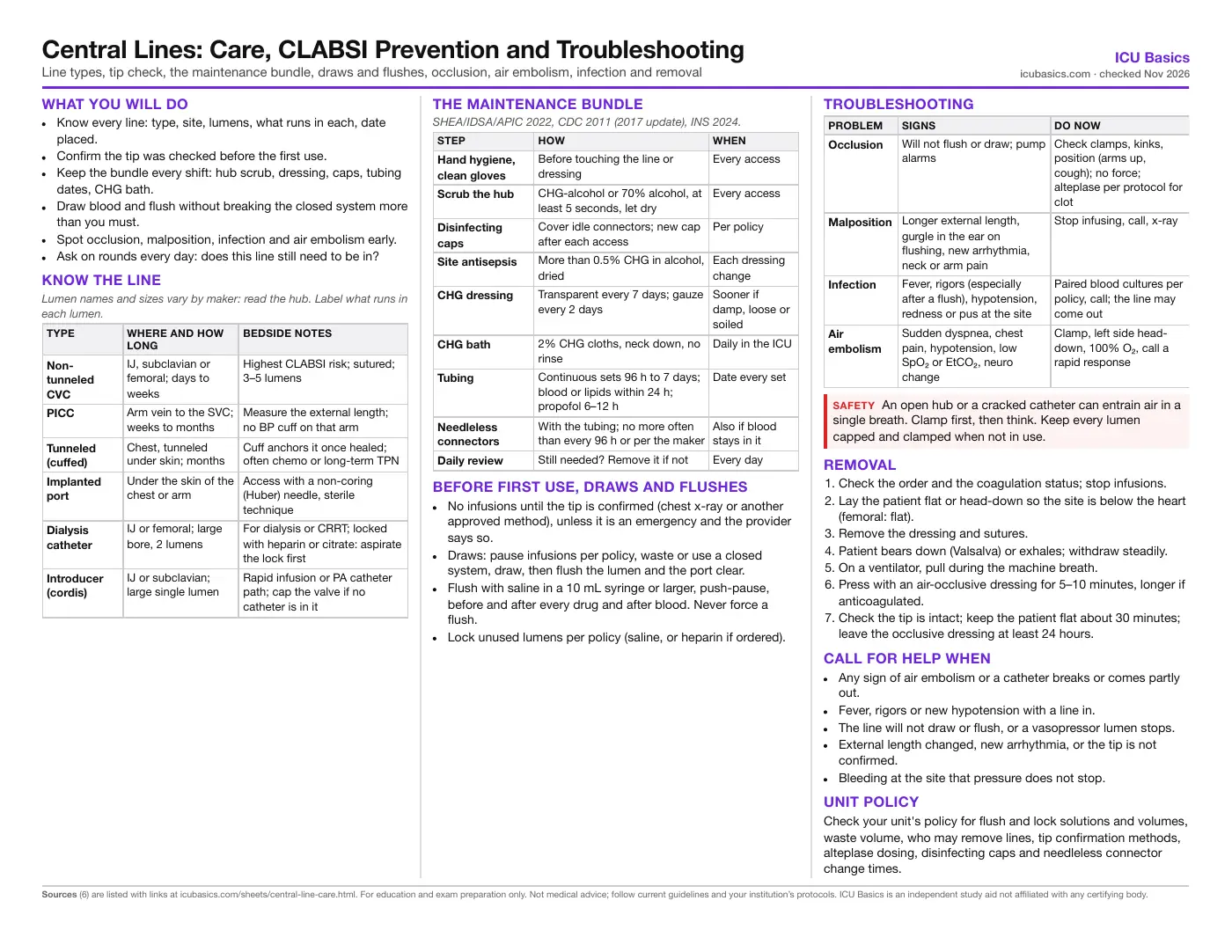
What you will do
- Know every line: type, site, lumens, what runs in each, date placed.
- Confirm the tip was checked before the first use.
- Keep the bundle every shift: hub scrub, dressing, caps, tubing dates, CHG bath.
- Draw blood and flush without breaking the closed system more than you must.
- Spot occlusion, malposition, infection and air embolism early.
- Ask on rounds every day: does this line still need to be in?
Know the line
| Type | Where and how long | Bedside notes |
|---|---|---|
| Non-tunneled CVC | IJ, subclavian or femoral; days to weeks | Highest CLABSI risk; sutured; 3–5 lumens |
| PICC | Arm vein to the SVC; weeks to months | Measure the external length; no BP cuff on that arm |
| Tunneled (cuffed) | Chest, tunneled under skin; months | Cuff anchors it once healed; often chemo or long-term TPN |
| Implanted port | Under the skin of the chest or arm | Access with a non-coring (Huber) needle, sterile technique |
| Dialysis catheter | IJ or femoral; large bore, 2 lumens | For dialysis or CRRT; locked with heparin or citrate: aspirate the lock first |
| Introducer (cordis) | IJ or subclavian; large single lumen | Rapid infusion or PA catheter path; cap the valve if no catheter is in it |
The maintenance bundle
| Step | How | When |
|---|---|---|
| Hand hygiene, clean gloves | Before touching the line or dressing | Every access |
| Scrub the hub | CHG-alcohol or 70% alcohol, at least 5 seconds, let dry | Every access |
| Disinfecting caps | Cover idle connectors; new cap after each access | Per policy |
| Site antisepsis | More than 0.5% CHG in alcohol, dried | Each dressing change |
| CHG dressing | Transparent every 7 days; gauze every 2 days | Sooner if damp, loose or soiled |
| CHG bath | 2% CHG cloths, neck down, no rinse | Daily in the ICU |
| Tubing | Continuous sets 96 h to 7 days; blood or lipids within 24 h; propofol 6–12 h | Date every set |
| Needleless connectors | With the tubing; no more often than every 96 h or per the maker | Also if blood stays in it |
| Daily review | Still needed? Remove it if not | Every day |
Before first use, draws and flushes
- No infusions until the tip is confirmed (chest x-ray or another approved method), unless it is an emergency and the provider says so.
- Draws: pause infusions per policy, waste or use a closed system, draw, then flush the lumen and the port clear.
- Flush with saline in a 10 mL syringe or larger, push-pause, before and after every drug and after blood. Never force a flush.
- Lock unused lumens per policy (saline, or heparin if ordered).
Troubleshooting
| Problem | Signs | Do now |
|---|---|---|
| Occlusion | Will not flush or draw; pump alarms | Check clamps, kinks, position (arms up, cough); no force; alteplase per protocol for clot |
| Malposition | Longer external length, gurgle in the ear on flushing, new arrhythmia, neck or arm pain | Stop infusing, call, x-ray |
| Infection | Fever, rigors (especially after a flush), hypotension, redness or pus at the site | Paired blood cultures per policy, call; the line may come out |
| Air embolism | Sudden dyspnea, chest pain, hypotension, low SpO₂ or EtCO₂, neuro change | Clamp, left side head-down, 100% O₂, call a rapid response |
Removal
- Check the order and the coagulation status; stop infusions.
- Lay the patient flat or head-down so the site is below the heart (femoral: flat).
- Remove the dressing and sutures.
- Patient bears down (Valsalva) or exhales; withdraw steadily.
- On a ventilator, pull during the machine breath.
- Press with an air-occlusive dressing for 5–10 minutes, longer if anticoagulated.
- Check the tip is intact; keep the patient flat about 30 minutes; leave the occlusive dressing at least 24 hours.
Call for help when
- Any sign of air embolism or a catheter breaks or comes partly out.
- Fever, rigors or new hypotension with a line in.
- The line will not draw or flush, or a vasopressor lumen stops.
- External length changed, new arrhythmia, or the tip is not confirmed.
- Bleeding at the site that pressure does not stop.
Unit policy
Check your unit's policy for flush and lock solutions and volumes, waste volume, who may remove lines, tip confirmation methods, alteplase dosing, disinfecting caps and needleless connector change times.
In depth
The one-page summary above is what the PDF prints. These sections go further.
Line types, lumens and what goes where
A central venous access device ends in a large central vein, so it can carry vasopressors, irritant or high-osmolarity drugs, parenteral nutrition and large volumes, and it allows central venous pressure and ScvO₂. Short-term non-tunneled catheters are placed at the bedside and carry the highest infection risk; tunneled catheters and ports, which have a longer path under the skin or no exit site at all, are for months of therapy.
- Lumens: most adult CVCs have a larger lumen (often the distal) that suits blood, CVP and rapid volume. Names and gauges differ by maker, so read the hub and the package insert your unit stocks.
- Give compatible infusions together and keep a dedicated lumen for parenteral nutrition where possible. Label each lumen and each infusion at the hub.
- PICCs: note the external length at insertion and check it each shift. Power-injectable PICCs and ports are labeled for contrast injection; others are not.
- Dialysis catheters are locked with concentrated heparin or citrate. Aspirate and discard the lock before use, or you bolus the patient. CDC advises using them only for dialysis.
- Introducers (cordis) are a short, large-bore sheath. Without a PA catheter in place, keep the valve capped with its obturator or a cap: an open valve is an air path.
- Implanted ports: access with a non-coring needle under sterile technique; the needle and dressing are changed on a set schedule, commonly every 7 days.
Tip position and malposition
For upper-body lines, the target is the lower superior vena cava near its junction with the right atrium (the cavoatrial junction). Tip position is checked before the first infusion with a chest x-ray, or with ECG-guided or ultrasound methods where the unit has them; a femoral line ends in the inferior vena cava and is not seen on a chest film. A tip too deep in the atrium can trigger arrhythmias; one that points up the internal jugular or across into the other arm (common with subclavian lines and PICCs) delivers irritant drugs into a small vein.
- Clues: a change in external length, a gurgling or rushing sound in the ear on flushing, neck, shoulder or arm pain or swelling, new ectopy, a CVP waveform that changes shape, or lumens that draw only with the patient in one position.
- Pinch-off: a subclavian catheter compressed between the clavicle and first rib works only with the arm raised and can fracture. Report a positional line rather than working around it.
- Never advance a catheter that has slid out: the exposed part is no longer sterile.
Occlusion: thrombotic and nonthrombotic
| Type | Typical story | Approach |
|---|---|---|
| Mechanical | Clamp closed, kink, tight suture, positional, pinch-off | Fix the cause; reposition; x-ray if suspected |
| Thrombotic | Gradual: flushes but will not draw, then neither; after blood draws | Alteplase per protocol |
| Precipitate | Sudden, after incompatible drugs (calcium with phosphate, some antibiotics) | Per pharmacy protocol; alteplase will not dissolve it |
| Lipid | After propofol or lipid nutrition | Per pharmacy protocol |
Alteplase (Cathflo Activase) for a suspected clot: 2 mg in 2 mL instilled gently into the occluded lumen for adults 30 kg or more (under 30 kg, 110% of the lumen volume, no more than 2 mg). Check at 30 minutes by trying to aspirate; if it still will not draw, check again at 120 minutes. A second equal dose may be given. Aspirate the drug before flushing. The label warns that dysfunction may come from malposition, mechanical failure, sutures or precipitates instead of clot, that excessive pressure should be avoided, and that an infected catheter can release infection into the bloodstream.
Air embolism
Air enters when the pressure in a central vein falls below the air pressure at an open hub: during inspiration, with the patient sitting up, through a disconnected or cracked catheter, an open introducer valve, or the track left after removal. Case reports put the lethal adult volume around 200–300 mL (3–5 mL/kg), and air can enter faster than expected.
- Signs: sudden dyspnea, cough, chest pain, tachycardia, hypotension, a drop in EtCO₂, hypoxemia (a late sign), new neuro deficits or seizure, and sometimes a churning murmur.
- Treatment: stop further air entry (clamp, cover the site), 100% oxygen, and left lateral head-down positioning (Durant's maneuver) to keep air in the right heart away from the outflow tract. Call for help; CPR if needed. A provider may try to aspirate air through a catheter in the right heart.
- If neuro signs suggest air reached the arterial side, keep the patient flat rather than head-down and ask about hyperbaric oxygen, which works best when started early.
- Prevention: lumens clamped and capped, Luer-lock connections, prime all tubing, never leave an introducer valve open, and use the removal steps on the one-pager.
CLABSI: the evidence behind the bundle
Short-term lines are colonized mostly from the skin along the outside of the catheter; longer-dwelling lines are colonized from the hub and connectors down the inside. The insertion bundle (on the central-line insertion checklist card) targets the first route; the maintenance bundle on this page targets both.
- SHEA/IDSA/APIC 2022 rates daily CHG bathing of ICU patients over 2 months old and CHG-containing dressings as essential practices. In a cluster crossover trial of 7,727 patients in nine ICUs and bone marrow transplant units, daily 2% CHG cloths lowered hospital-acquired bloodstream infections (4.78 vs 6.60 per 1,000 patient-days, Climo 2013).
- Bathing technique: 2% CHG cloths from the jaw down, including the first few inches of lines and tubes near the body; avoid eyes, ears and mucous membranes; do not rinse; use only CHG-compatible lotions.
- Scrub the hub at least 5 seconds with alcoholic CHG (preferred) or 70% alcohol. Antiseptic caps are an additional approach; SHEA notes they are not better than a good manual scrub.
- CDC 2011 sets needleless connector changes no more often than every 72 hours or per the maker; INS 2024 practice uses 96 hours. Follow your product and policy.
- Do not replace lines on a schedule or over a guidewire to prevent infection (CDC 2011). Removal of lines that are no longer needed is the strongest prevention there is.
Suspected line infection
The site often looks clean even when the line is infected. Suspect it with fever, rigors (especially just after a flush), unexplained hypotension or rising lactate, or a new positive blood culture with no other source. Draw paired blood cultures, one through the line and one by venipuncture, before antibiotics if it causes no delay. Pus at the exit site, a tunnel infection or septic shock usually means the line comes out; a new line goes in at a new site, not over a guidewire. Send the tip only if it is ordered.
Removal in more detail
Air embolism after removal happens through the skin-to-vein track, so the steps raise venous pressure at the site and seal the track. Position the patient supine or head-down with the site below the heart, ask for a Valsalva (or remove during exhalation if they cannot), and, for a patient on positive-pressure ventilation, withdraw during the machine breath. Hold pressure with an airtight dressing for 5–10 minutes or until bleeding stops, keep the patient flat about 30 minutes, and leave the occlusive dressing on at least 24 hours. Inspect the catheter for an intact tip and report any missing piece at once. Tunneled catheters and ports are removed by a provider.
Related cheat sheets
- Your First Weeks in the ICUHow ICU orientation works, getting the most from your preceptor, organizing a shift, and speaking up for safety
- ICU Report Sheet: SBAR Brain Sheet for NursesA typical ICU shift hour by hour, a printable system-by-system report layout, SBAR handoff and what to check together at the bedside
- Drawing ICU Labs: Order of Draw, Cultures and Timed LabsOrder of draw, line draws without contamination, blood cultures, blood gases, labeling and the labs that run on a clock
- Daily Bedside Screens: Skin, Falls, Swallow and WithdrawalPressure injury risk, fall risk, the post-extubation swallow screen and CIWA-Ar, and what to do with each result
- Early Mobility in the ICUWhy it matters, a step-by-step progression, the safety screen before and stop criteria during a session, team roles, equipment and documentation
- Leaving the Unit: CT, MRI, IR, Cath Lab and ORIs the trip worth it, who goes, what travels, monitoring and handoff, then what to check at each destination
Sources
- Buetti N, Marschall J, Drees M, et al. Strategies to prevent central line-associated bloodstream infections in acute-care hospitals: 2022 update. Infect Control Hosp Epidemiol. 2022;43(5):553–569. Link
- CDC. Guidelines for the Prevention of Intravascular Catheter-Related Infections (2011, updated 2017): summary of recommendations (page updated 2024). Link
- Nickel B, Gorski L, Kleidon T, et al. Infusion Therapy Standards of Practice, 9th edition. J Infus Nurs. 2024;47(1S Suppl 1):S1–S285. Link
- Climo MW, Yokoe DS, Warren DK, et al. Effect of daily chlorhexidine bathing on hospital-acquired infection. N Engl J Med. 2013;368:533–542. Link
- McCarthy CJ, Behravesh S, Naidu SG, Oklu R. Air embolism: practical tips for prevention and treatment. J Clin Med. 2016;5(11):93. Link
- Genentech. Cathflo Activase (alteplase) prescribing information. DailyMed, January 2026. Link