 ICU Basics
Cheat Sheet
Daily Bedside Screens: Skin, Falls, Swallow and Withdrawal
Pressure injury risk, fall risk, the post-extubation swallow screen and CIWA-Ar, and what to do with each result
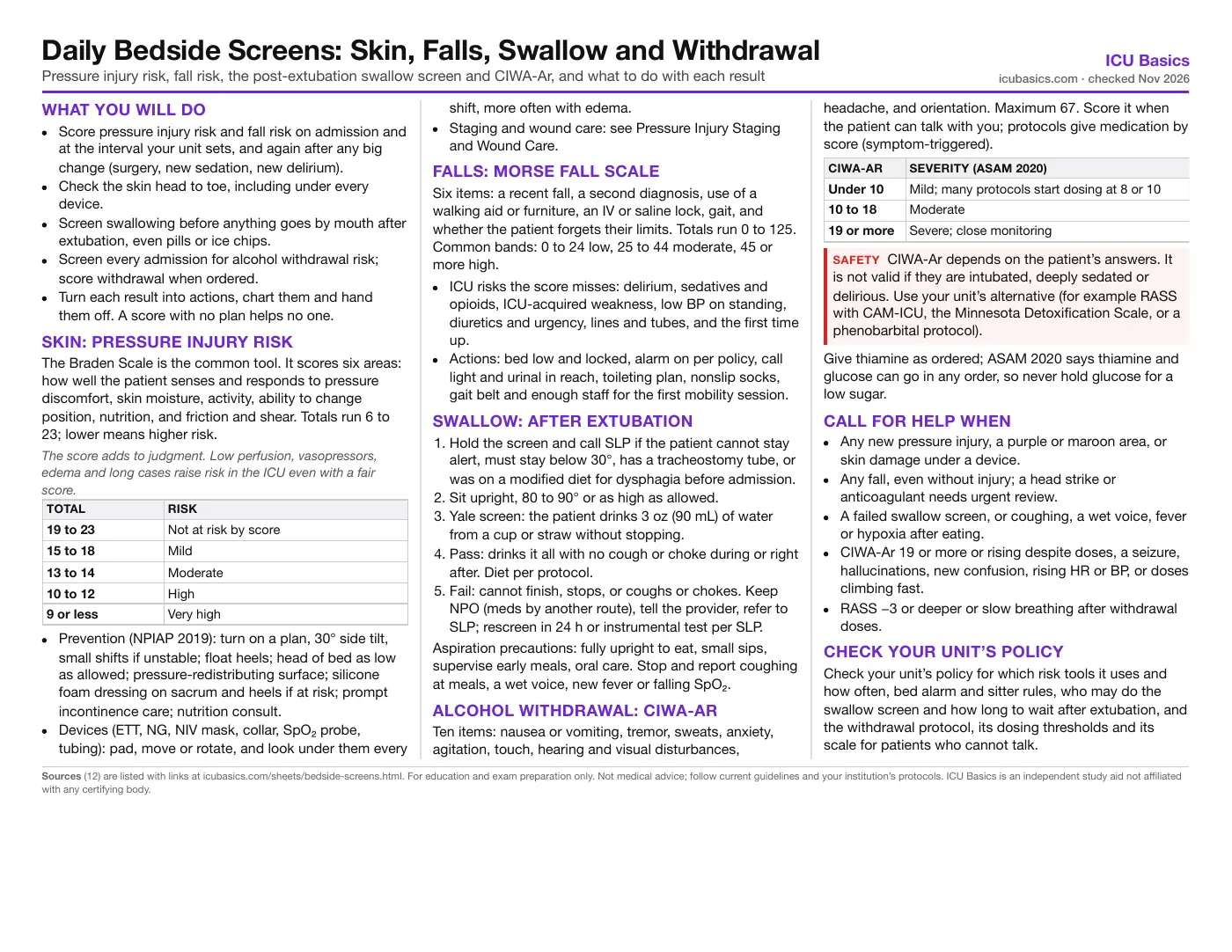
What you will do
- Score pressure injury risk and fall risk on admission and at the interval your unit sets, and again after any big change (surgery, new sedation, new delirium).
- Check the skin head to toe, including under every device.
- Screen swallowing before anything goes by mouth after extubation, even pills or ice chips.
- Screen every admission for alcohol withdrawal risk; score withdrawal when ordered.
- Turn each result into actions, chart them and hand them off. A score with no plan helps no one.
Skin: Pressure Injury Risk
The Braden Scale is the common tool. It scores six areas: how well the patient senses and responds to pressure discomfort, skin moisture, activity, ability to change position, nutrition, and friction and shear. Totals run 6 to 23; lower means higher risk.
| Total | Risk |
|---|---|
| 19 to 23 | Not at risk by score |
| 15 to 18 | Mild |
| 13 to 14 | Moderate |
| 10 to 12 | High |
| 9 or less | Very high |
- Prevention (NPIAP 2019): turn on a plan, 30° side tilt, small shifts if unstable; float heels; head of bed as low as allowed; pressure-redistributing surface; silicone foam dressing on sacrum and heels if at risk; prompt incontinence care; nutrition consult.
- Devices (ETT, NG, NIV mask, collar, SpO₂ probe, tubing): pad, move or rotate, and look under them every shift, more often with edema.
- Staging and wound care: see Pressure Injury Staging and Wound Care.
Falls: Morse Fall Scale
Six items: a recent fall, a second diagnosis, use of a walking aid or furniture, an IV or saline lock, gait, and whether the patient forgets their limits. Totals run 0 to 125. Common bands: 0 to 24 low, 25 to 44 moderate, 45 or more high.
- ICU risks the score misses: delirium, sedatives and opioids, ICU-acquired weakness, low BP on standing, diuretics and urgency, lines and tubes, and the first time up.
- Actions: bed low and locked, alarm on per policy, call light and urinal in reach, toileting plan, nonslip socks, gait belt and enough staff for the first mobility session.
Swallow: After Extubation
- Hold the screen and call SLP if the patient cannot stay alert, must stay below 30°, has a tracheostomy tube, or was on a modified diet for dysphagia before admission.
- Sit upright, 80 to 90° or as high as allowed.
- Yale screen: the patient drinks 3 oz (90 mL) of water from a cup or straw without stopping.
- Pass: drinks it all with no cough or choke during or right after. Diet per protocol.
- Fail: cannot finish, stops, or coughs or chokes. Keep NPO (meds by another route), tell the provider, refer to SLP; rescreen in 24 h or instrumental test per SLP.
Aspiration precautions: fully upright to eat, small sips, supervise early meals, oral care. Stop and report coughing at meals, a wet voice, new fever or falling SpO₂.
Alcohol Withdrawal: CIWA-Ar
Ten items: nausea or vomiting, tremor, sweats, anxiety, agitation, touch, hearing and visual disturbances, headache, and orientation. Maximum 67. Score it when the patient can talk with you; protocols give medication by score (symptom-triggered).
| CIWA-Ar | Severity (ASAM 2020) |
|---|---|
| Under 10 | Mild; many protocols start dosing at 8 or 10 |
| 10 to 18 | Moderate |
| 19 or more | Severe; close monitoring |
Give thiamine as ordered; ASAM 2020 says thiamine and glucose can go in any order, so never hold glucose for a low sugar.
Call for help when
- Any new pressure injury, a purple or maroon area, or skin damage under a device.
- Any fall, even without injury; a head strike or anticoagulant needs urgent review.
- A failed swallow screen, or coughing, a wet voice, fever or hypoxia after eating.
- CIWA-Ar 19 or more or rising despite doses, a seizure, hallucinations, new confusion, rising HR or BP, or doses climbing fast.
- RASS −3 or deeper or slow breathing after withdrawal doses.
Check your unit’s policy
Check your unit’s policy for which risk tools it uses and how often, bed alarm and sitter rules, who may do the swallow screen and how long to wait after extubation, and the withdrawal protocol, its dosing thresholds and its scale for patients who cannot talk.
In depth
The one-page summary above is what the PDF prints. These sections go further.
Pressure Injury Risk in the ICU
Risk tools were built mostly outside critical care. They capture mobility, moisture and nutrition well but miss ICU factors: low perfusion, vasopressor use, edema, long operations, hypothermia, and the fact that some unstable patients cannot be turned. The 2019 international guideline asks for a structured risk assessment that adds these factors to the score and to a full skin check, as soon as possible after admission and again with any change.
- Skin check: bony points (sacrum, coccyx, heels, ischia, occiput, ears), skin folds, and under every device and tape edge. In dark skin, look for warmth, coolness, firmness or a color change compared with nearby skin, since redness may not show.
- Turning: individualize the schedule; a 30° tilt loads less bone than a full side-lying turn. If a full turn drops BP or SpO₂, turn slowly, make small weight shifts, and try again when stable.
- Heels: float them off the bed with a pillow under the calves or a heel boot; do not rest them on a rolled towel.
- Head of bed: as low as the patient’s condition allows; 30° meets the ventilator bundle and limits shear better than higher angles.
- Prophylactic dressing: a multilayer silicone foam on the sacrum and heels for at-risk patients; lift it each shift to look underneath.
- Nutrition: involve the dietitian early. For at-risk patients with malnutrition, guideline targets are about 30 to 35 kcal/kg and 1.25 to 1.5 g/kg protein a day, adjusted by the team.
Device-Related Pressure Injury
A device-related pressure injury takes the shape of the device and is staged like any other pressure injury, except injuries on mucous membranes (lips, tongue, nares) are not staged. Common ICU culprits are the endotracheal tube and its holder, NG tubes, NIV masks, cervical collars, oxygen tubing over the ears, SpO₂ probes, arterial line hubs, urinary catheters and compression sleeves.
- Choose the right size and fit; avoid placing the patient on tubing or connectors.
- Pad high-pressure points with a thin prophylactic dressing where the device allows.
- Rotate or move devices when safe (for example SpO₂ probe site, ETT position with a second person per policy).
- Look under devices at least twice a day, more often with fluid shifts or edema, and remove any device as soon as it is no longer needed.
Falls in Critical Care
Falls in the ICU are less common than on wards but often happen at predictable moments: a delirious patient climbing out of bed, a first walk after days of bed rest, a rush to the bathroom after a diuretic, or a step-down patient who still has ICU-level weakness. The Morse Fall Scale was developed on general hospital units, and its mental status item only asks whether the patient overestimates their abilities, so treat it as a floor, not a ceiling.
- Check orthostatic tolerance before standing: dangle first, watch HR, BP and symptoms.
- Plan mobility with PT and enough hands; secure lines, drains and the airway before moving.
- Treat the cause of delirium and review sedatives with the team; a fall risk score cannot fix delirium.
- After a fall: stay with the patient, assess for injury before moving them, check glucose and neuro status, notify the provider, follow the post-fall policy (imaging for a head strike or anticoagulation), and complete an event report.
Why Swallowing Fails After Extubation
Post-extubation dysphagia comes from direct tube injury to the larynx, swelling, reduced throat sensation, ICU-acquired weakness, sedation and poor coordination of breathing and swallowing. Reported rates range from 3% to 62%; a large systematic screening study found about 12%. The longer the patient was intubated, the higher the risk. Dysphagia is linked to aspiration pneumonia, reintubation, longer stays and higher mortality.
- The Yale 3-ounce water challenge is very sensitive: a patient who passes rarely aspirates thin liquid. It is not specific: many who fail can still eat, which is why a fail leads to SLP review rather than a permanent NPO order.
- Nurses trained in the protocol can give it with accuracy close to SLPs (Warner 2014).
- The cognitive check (name, place, date, simple commands) and an oral exam (lip closure, tongue movement, facial symmetry) inform the risk but are not by themselves reasons to skip the screen.
- No bedside screen catches every silent aspirator. Keep watching at meals, and refer when coughing, a wet voice, fever or new infiltrates appear.
- A failed screen means no oral meds as well. Ask the provider for other routes or a feeding plan.
Alcohol Withdrawal in the ICU
ASAM 2020 asks that every hospital admission be screened for withdrawal risk (for example with AUDIT-C or AUDIT-PC); PAWSS can predict severe or complicated withdrawal in medically ill patients. In the ICU, the history is often missing, so the guideline favors early, protocolized treatment for patients thought to be dependent, given IV.
- Timing: symptoms often start within hours of the last drink; withdrawal delirium usually starts 24 to 48 hours after stopping but can appear 3 to 5 days later.
- CIWA-Ar items score 0 to 7 each, except orientation 0 to 4. Pulse and BP are recorded but not scored.
- Confounders: fever, sepsis, hypoxia, pain, other withdrawal and drugs such as beta blockers can raise or mask the score. ASAM says a low score is usually reliable, but read a high score with caution.
- Patients who cannot talk: ASAM lists RASS, CAM-ICU, the Delirium Detection Score and the Minnesota Detoxification Scale as options. Many ICUs now use phenobarbital protocols. Use whichever your unit has approved.
- Resistant withdrawal: symptoms persist despite high benzodiazepine doses. Definitions vary (studies used 200 mg diazepam in 4 hours, or 40 to 50 mg IV diazepam in 1 hour). Options include adjunct phenobarbital with close monitoring, propofol for a patient already on the ventilator, and dexmedetomidine as an add-on for symptoms (it does not prevent seizures).
- Supportive care: thiamine (IV or IM preferred in the ICU), magnesium when low or with arrhythmia or prior seizures, phosphorus if under 1 mg/dL (0.32 mmol/L), fluids and electrolytes.
- Safety: higher sedative doses need continuous SpO₂ and close RASS checks, with airway equipment at hand. Restraints only to prevent injury and per law and policy.
Related cheat sheets
- Your First Weeks in the ICUHow ICU orientation works, getting the most from your preceptor, organizing a shift, and speaking up for safety
- ICU Report Sheet: SBAR Brain Sheet for NursesA typical ICU shift hour by hour, a printable system-by-system report layout, SBAR handoff and what to check together at the bedside
- Drawing ICU Labs: Order of Draw, Cultures and Timed LabsOrder of draw, line draws without contamination, blood cultures, blood gases, labeling and the labs that run on a clock
- Early Mobility in the ICUWhy it matters, a step-by-step progression, the safety screen before and stop criteria during a session, team roles, equipment and documentation
- Leaving the Unit: CT, MRI, IR, Cath Lab and ORIs the trip worth it, who goes, what travels, monitoring and handoff, then what to check at each destination
- Central Lines: Care, CLABSI Prevention and TroubleshootingLine types, tip check, the maintenance bundle, draws and flushes, occlusion, air embolism, infection and removal
Calculators for this topic
Sources
- European Pressure Ulcer Advisory Panel, National Pressure Injury Advisory Panel, Pan Pacific Pressure Injury Alliance. Prevention and Treatment of Pressure Ulcers/Injuries: Clinical Practice Guideline. The International Guideline. 3rd ed. 2019. Link
- Bergstrom N, Braden BJ, Laguzza A, et al. The Braden Scale for predicting pressure sore risk. Nurs Res. 1987;36(4):205–210. Link
- Bergstrom N, Braden B, Kemp M, Champagne M, et al. Predicting pressure ulcer risk: a multisite study of the predictive validity of the Braden Scale. Nurs Res. 1998;47(5):261–269. Link
- Morse JM, Black C, Oberle K, Donahue P. A prospective study to identify the fall-prone patient. Soc Sci Med. 1989;28(1):81–86. Link
- Fall TIPS. Frequently asked questions: use of the Morse Fall Scale. Link
- Suiter DM, Sloggy J, Leder SB. Validation of the Yale Swallow Protocol: a prospective double-blinded videofluoroscopic study. Dysphagia. 2014;29(2):199–203. Link
- Leder SB, Suiter DM. Five days of successful oral alimentation for hospitalized patients based upon passing the Yale Swallow Protocol. Ann Otol Rhinol Laryngol. 2014;123(9):609–613. Link
- Leder SB, Suiter DM, Warner HL, Kaplan LJ. Initiating safe oral feeding in critically ill intensive care and step-down unit patients based on passing a 3-ounce (90 milliliters) water swallow challenge. J Trauma. 2011;70(5):1203–1207. Link
- Warner HL, Suiter DM, Nystrom KV, et al. Comparing accuracy of the Yale swallow protocol when administered by registered nurses and speech-language pathologists. J Clin Nurs. 2014;23(13-14):1908–1915. Link
- Zuercher P, Moret CS, Dziewas R, Schefold JC. Dysphagia in the intensive care unit: epidemiology, mechanisms, and clinical management. Crit Care. 2019;23:103. Link
- Sullivan JT, Sykora K, Schneiderman J, Naranjo CA, Sellers EM. Assessment of alcohol withdrawal: the revised Clinical Institute Withdrawal Assessment for Alcohol scale (CIWA-Ar). Br J Addict. 1989;84(11):1353–1357. Link
- American Society of Addiction Medicine. The ASAM Clinical Practice Guideline on Alcohol Withdrawal Management. J Addict Med. 2020;14(3S Suppl 1):1–72. Link