 ICU Basics
Cheat Sheet
Your First Weeks in the ICU
How ICU orientation works, getting the most from your preceptor, organizing a shift, and speaking up for safety
What you will do
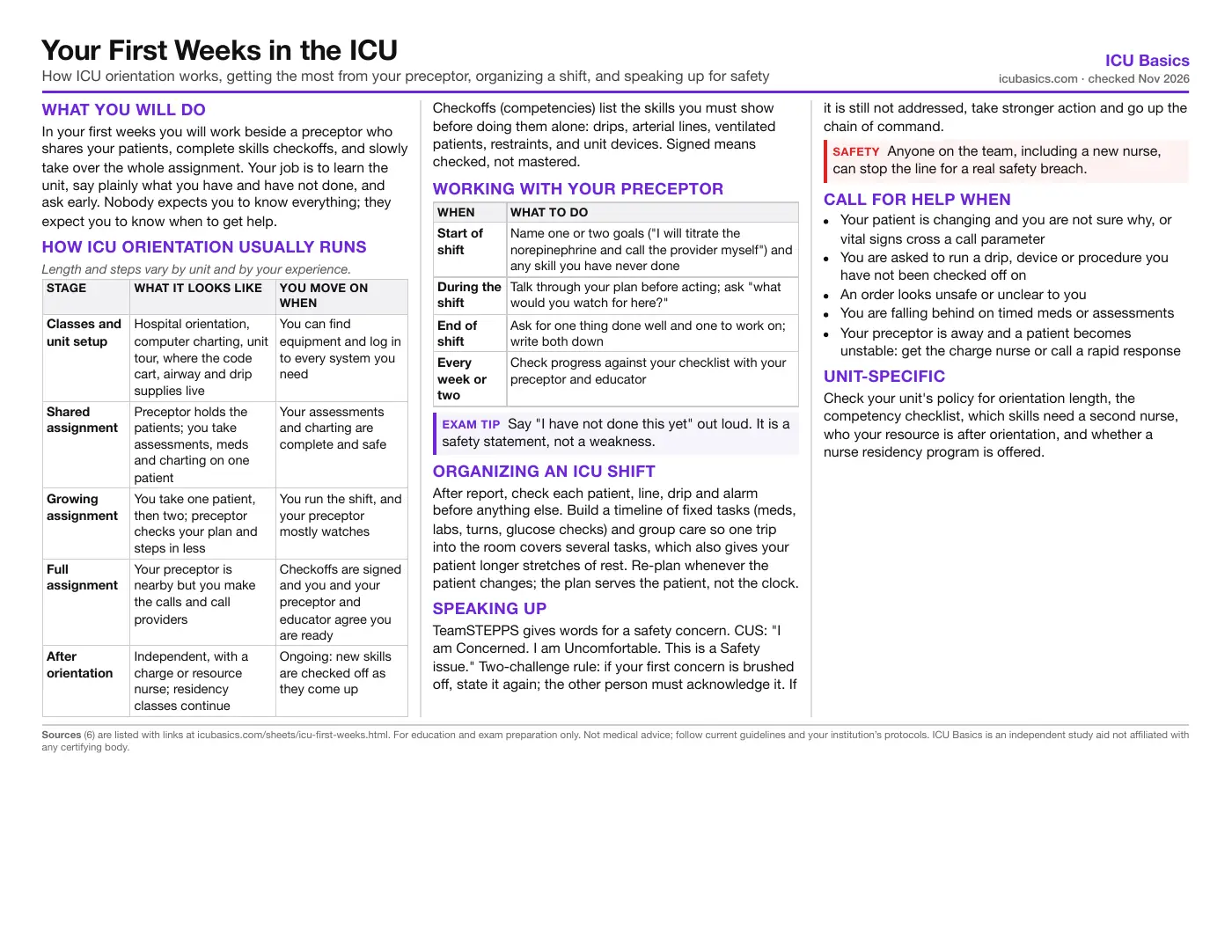
In your first weeks you will work beside a preceptor who shares your patients, complete skills checkoffs, and slowly take over the whole assignment. Your job is to learn the unit, say plainly what you have and have not done, and ask early. Nobody expects you to know everything; they expect you to know when to get help.
How ICU orientation usually runs
| Stage | What it looks like | You move on when |
|---|---|---|
| Classes and unit setup | Hospital orientation, computer charting, unit tour, where the code cart, airway and drip supplies live | You can find equipment and log in to every system you need |
| Shared assignment | Preceptor holds the patients; you take assessments, meds and charting on one patient | Your assessments and charting are complete and safe |
| Growing assignment | You take one patient, then two; preceptor checks your plan and steps in less | You run the shift, and your preceptor mostly watches |
| Full assignment | Your preceptor is nearby but you make the calls and call providers | Checkoffs are signed and you and your preceptor and educator agree you are ready |
| After orientation | Independent, with a charge or resource nurse; residency classes continue | Ongoing: new skills are checked off as they come up |
Checkoffs (competencies) list the skills you must show before doing them alone: drips, arterial lines, ventilated patients, restraints, and unit devices. Signed means checked, not mastered.
Working with your preceptor
| When | What to do |
|---|---|
| Start of shift | Name one or two goals ("I will titrate the norepinephrine and call the provider myself") and any skill you have never done |
| During the shift | Talk through your plan before acting; ask "what would you watch for here?" |
| End of shift | Ask for one thing done well and one to work on; write both down |
| Every week or two | Check progress against your checklist with your preceptor and educator |
Organizing an ICU shift
After report, check each patient, line, drip and alarm before anything else. Build a timeline of fixed tasks (meds, labs, turns, glucose checks) and group care so one trip into the room covers several tasks, which also gives your patient longer stretches of rest. Re-plan whenever the patient changes; the plan serves the patient, not the clock.
Speaking up
TeamSTEPPS gives words for a safety concern. CUS: "I am Concerned. I am Uncomfortable. This is a Safety issue." Two-challenge rule: if your first concern is brushed off, state it again; the other person must acknowledge it. If it is still not addressed, take stronger action and go up the chain of command.
Call for help when
- Your patient is changing and you are not sure why, or vital signs cross a call parameter
- You are asked to run a drip, device or procedure you have not been checked off on
- An order looks unsafe or unclear to you
- You are falling behind on timed meds or assessments
- Your preceptor is away and a patient becomes unstable: get the charge nurse or call a rapid response
Unit-specific
Check your unit's policy for orientation length, the competency checklist, which skills need a second nurse, who your resource is after orientation, and whether a nurse residency program is offered.
In depth
The one-page summary above is what the PDF prints. These sections go further.
Novice to expert: why the first year feels hard
Patricia Benner applied the Dreyfus model of skill learning to nursing. New nurses lean on rules because they have not yet seen enough patients to recognize patterns. That is normal, and orientation is built around it.
| Stage | How it shows up | What helps |
|---|---|---|
| Novice | Follows rules and checklists; struggles when the patient does not match the textbook | Clear steps, protocols, a preceptor close by |
| Advanced beginner | Notices recurring features of situations but cannot yet rank them; most new grads start here | Help setting priorities; talking through why one finding matters more |
| Competent | Plans ahead with conscious goals; Benner described this at about 2 to 3 years in a similar setting | Complex patients, charge orientation, precepting students |
| Proficient | Sees the whole situation and notices when the expected picture is missing | Case reviews, mentoring others |
| Expert | Grasps situations quickly and intuitively, and falls back on careful analysis when a situation is new | Teaching, practice change, research |
The practical point: ask your preceptor to say what they notice and why. Expert reasoning is fast and often unspoken, and hearing it out loud is one of the quickest ways to build your own pattern library.
What the evidence says about transition programs
The NCSBN Transition to Practice study followed 1,088 new graduate nurses in 105 hospitals in three states through their first year. Hospitals with established transition programs kept more of their new nurses, and those nurses reported fewer patient care errors, fewer unsafe practices, higher competence, less stress and more job satisfaction.
- Outcomes were better when the program was formal and backed by hospital leaders, used a preceptor trained for the role, and lasted 9 to 12 months.
- The NCSBN model gives a trained preceptor for the first 6 months, then 6 months of institutional support (committees, unit projects, classes).
- Its content covers patient-centered care, communication and teamwork, evidence-based practice, quality improvement, informatics, safety and clinical reasoning, with feedback and reflection all year.
What this means for you: orientation ending does not mean learning support ends. If your hospital has a nurse residency, join it; if not, ask your educator who your support person is for the rest of the first year.
Getting the most from preceptor feedback
Feedback works best when it is specific and frequent. Short daily feedback beats a long talk at the end of orientation, when it is too late to change much. Bring your own list: "Today I want feedback on how I prioritized at 0800" gets you a useful answer; "How did I do?" usually gets "fine".
- Keep a running list of skills you have done, seen and not yet seen. Share it so your preceptor can steer you toward the gaps (a CRRT patient, a new central line, a rapid response).
- If you and your preceptor do not work well together, talk to your educator or manager early. A different preceptor is a normal request, not a complaint.
- If you feel you need more time, say so before orientation ends. Extending orientation is common and far better than going on alone too soon.
Learning outside your shifts
Use short, steady study rather than long catch-up sessions. A good pattern is to pick the main problem of a patient you cared for and read about it within a day or two, while the picture is fresh.
| Resource | Use it for |
|---|---|
| Unit protocols and policies | Drip titration rules, sedation and SAT/SBT steps, restraint rules, device care; these are what you will be held to |
| Unit educator and clinical nurse specialist | Skills you have not seen, checkoff sign-off, extra simulation time |
| Critical care orientation course (such as AACN ECCO, if your hospital provides it) | Self-paced, case-based modules on common ICU conditions, assessment and complications |
| Drug references and pharmacists | Drips, compatibility, high-alert meds |
| This app's One-Pagers and question bank | A system at a time, matched to the patients you are seeing |
A first-year learning plan
Write a simple plan with your educator or preceptor and look at it every month or two. One possible shape:
| Period | Focus |
|---|---|
| Orientation | Safe assessment, meds and drips, unit devices, charting, knowing when to call |
| First months alone | Your most common patient types; organizing two patients; calling providers with SBAR |
| Mid-year | Less common devices and procedures (CRRT, pacing, proning, transport); rapid responses and codes as a team member |
| End of year | Review gaps, set goals for year two, look at certification eligibility (for example CCRN) and unit committees |
CCRN eligibility is based on direct-care hours with acutely or critically ill patients; check the current AACN exam handbook for the exact hours before you plan a test date.
Healthy work environment and safety culture
AACN names six standards for a healthy work environment: skilled communication, true collaboration, effective decision making, appropriate staffing, meaningful recognition and authentic leadership. For a new nurse, skilled communication and true collaboration are the ones you use every shift: say what you see, ask what others see, and expect respect in return.
- Speak up early and specifically: name the finding, the concern and what you need ("MAP 58 for 15 minutes on norepinephrine 0.2 mcg/kg/min; I am concerned; I need you to see the patient").
- Use CUS when a plain concern is not heard, and the two-challenge rule when it is still not addressed.
- Report errors and near misses through your hospital system. Reporting is how units fix weak systems; it is not a confession.
- If you are treated with disrespect, tell your manager or educator. Behavior that makes people afraid to speak up is a patient safety problem.
Related cheat sheets
- ICU Report Sheet: SBAR Brain Sheet for NursesA typical ICU shift hour by hour, a printable system-by-system report layout, SBAR handoff and what to check together at the bedside
- Drawing ICU Labs: Order of Draw, Cultures and Timed LabsOrder of draw, line draws without contamination, blood cultures, blood gases, labeling and the labs that run on a clock
- Daily Bedside Screens: Skin, Falls, Swallow and WithdrawalPressure injury risk, fall risk, the post-extubation swallow screen and CIWA-Ar, and what to do with each result
- Early Mobility in the ICUWhy it matters, a step-by-step progression, the safety screen before and stop criteria during a session, team roles, equipment and documentation
- Leaving the Unit: CT, MRI, IR, Cath Lab and ORIs the trip worth it, who goes, what travels, monitoring and handoff, then what to check at each destination
- Central Lines: Care, CLABSI Prevention and TroubleshootingLine types, tip check, the maintenance bundle, draws and flushes, occlusion, air embolism, infection and removal
Sources
- Spector N, Blegen MA, Silvestre J, et al. Transition to practice study in hospital settings. J Nurs Regul. 2015;5(4):24-38. Link
- National Council of State Boards of Nursing. Transition to Practice: study results. Link
- American Association of Critical-Care Nurses. AACN Standards for Establishing and Sustaining Healthy Work Environments. Link
- American Association of Critical-Care Nurses. Essentials of Critical Care Orientation (ECCO), course overview. Link
- Benner P. From novice to expert. Am J Nurs. 1982;82(3):402-407. Link
- Agency for Healthcare Research and Quality. TeamSTEPPS Pocket Guide (Mutual Support: Two-Challenge Rule, CUS, DESC). Copy hosted by NACHC. Link