 ICU Basics
Cheat Sheet
Staying Well in the ICU: Stress, Moral Distress and Life After the ICU
Burnout, compassion fatigue, moral distress and the 4 A's, support after errors, sleep, PICS and PICS-F, diaries and family presence
Practice 5 Staying Well in the ICU: Stress, Moral Distress and Life After the ICU questions
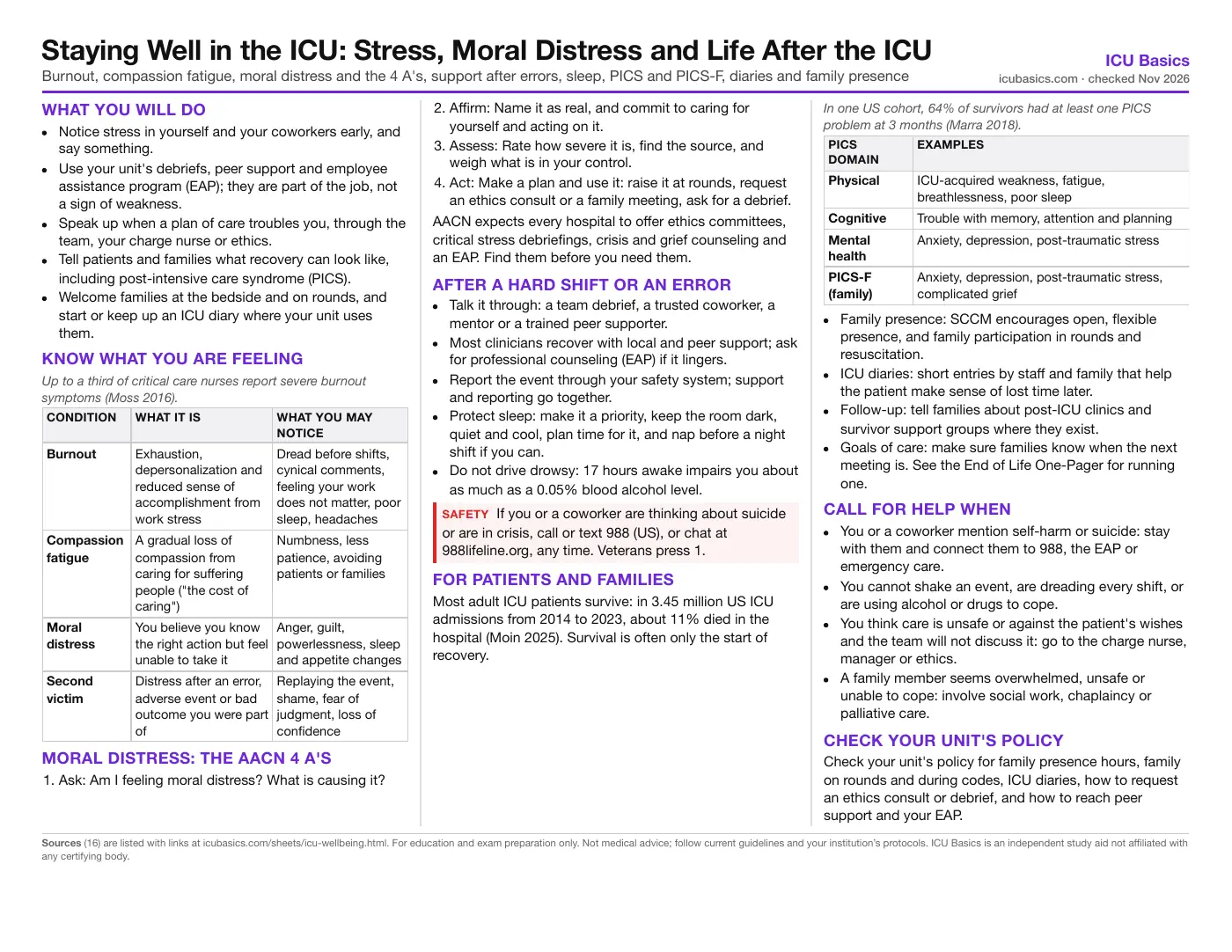
What you will do
- Notice stress in yourself and your coworkers early, and say something.
- Use your unit's debriefs, peer support and employee assistance program (EAP); they are part of the job, not a sign of weakness.
- Speak up when a plan of care troubles you, through the team, your charge nurse or ethics.
- Tell patients and families what recovery can look like, including post-intensive care syndrome (PICS).
- Welcome families at the bedside and on rounds, and start or keep up an ICU diary where your unit uses them.
Know what you are feeling
| Condition | What it is | What you may notice |
|---|---|---|
| Burnout | Exhaustion, depersonalization and reduced sense of accomplishment from work stress | Dread before shifts, cynical comments, feeling your work does not matter, poor sleep, headaches |
| Compassion fatigue | A gradual loss of compassion from caring for suffering people ("the cost of caring") | Numbness, less patience, avoiding patients or families |
| Moral distress | You believe you know the right action but feel unable to take it | Anger, guilt, powerlessness, sleep and appetite changes |
| Second victim | Distress after an error, adverse event or bad outcome you were part of | Replaying the event, shame, fear of judgment, loss of confidence |
Moral distress: the AACN 4 A's
- Ask: Am I feeling moral distress? What is causing it?
- Affirm: Name it as real, and commit to caring for yourself and acting on it.
- Assess: Rate how severe it is, find the source, and weigh what is in your control.
- Act: Make a plan and use it: raise it at rounds, request an ethics consult or a family meeting, ask for a debrief.
AACN expects every hospital to offer ethics committees, critical stress debriefings, crisis and grief counseling and an EAP. Find them before you need them.
After a hard shift or an error
- Talk it through: a team debrief, a trusted coworker, a mentor or a trained peer supporter.
- Most clinicians recover with local and peer support; ask for professional counseling (EAP) if it lingers.
- Report the event through your safety system; support and reporting go together.
- Protect sleep: make it a priority, keep the room dark, quiet and cool, plan time for it, and nap before a night shift if you can.
- Do not drive drowsy: 17 hours awake impairs you about as much as a 0.05% blood alcohol level.
For patients and families
Most adult ICU patients survive: in 3.45 million US ICU admissions from 2014 to 2023, about 11% died in the hospital (Moin 2025). Survival is often only the start of recovery.
| PICS domain | Examples |
|---|---|
| Physical | ICU-acquired weakness, fatigue, breathlessness, poor sleep |
| Cognitive | Trouble with memory, attention and planning |
| Mental health | Anxiety, depression, post-traumatic stress |
| PICS-F (family) | Anxiety, depression, post-traumatic stress, complicated grief |
- Family presence: SCCM encourages open, flexible presence, and family participation in rounds and resuscitation.
- ICU diaries: short entries by staff and family that help the patient make sense of lost time later.
- Follow-up: tell families about post-ICU clinics and survivor support groups where they exist.
- Goals of care: make sure families know when the next meeting is. See the End of Life One-Pager for running one.
Call for help when
- You or a coworker mention self-harm or suicide: stay with them and connect them to 988, the EAP or emergency care.
- You cannot shake an event, are dreading every shift, or are using alcohol or drugs to cope.
- You think care is unsafe or against the patient's wishes and the team will not discuss it: go to the charge nurse, manager or ethics.
- A family member seems overwhelmed, unsafe or unable to cope: involve social work, chaplaincy or palliative care.
Check your unit's policy
Check your unit's policy for family presence hours, family on rounds and during codes, ICU diaries, how to request an ethics consult or debrief, and how to reach peer support and your EAP.
In depth
The one-page summary above is what the PDF prints. These sections go further.
Burnout in critical care: the evidence
The Critical Care Societies Collaborative (AACN, CHEST, ATS and SCCM) issued a joint call to action in 2016 (Moss). It describes burnout as three linked features measured by the Maslach Burnout Inventory: emotional exhaustion, depersonalization (a distant, cynical or callous attitude toward patients and coworkers) and reduced personal accomplishment. Across studies, about 25–33% of critical care nurses had severe burnout symptoms and up to 86% had at least one feature; emotional exhaustion was the most common (73%). Up to 45% of critical care physicians reported severe burnout. These numbers predate COVID-19; in AACN's October 2021 survey of more than 9,000 nurses, 67% planned to leave their current position within 3 years, up from 54% in 2018.
ICU-specific triggers include end-of-life decisions, caring for patients who seem unlikely to benefit, conflict, heavy workload and poor work culture. Burnout tends to cluster on units, a "contagion" effect. Linked harms include post-traumatic stress symptoms (22–29% of critical care nurses; up to 18% met criteria), turnover and intent to leave nursing, and lower quality of care.
The National Academy of Medicine (2019) concluded that burnout is mainly a systems problem: workload, workflow, documentation burden, staffing and culture drive it, so the fix belongs to organizations as well as individuals. AACN's six healthy work environment standards (skilled communication, true collaboration, effective decision-making, appropriate staffing, meaningful recognition, authentic leadership) are the nursing framework for that systems work.
- Individual: adequate rest, exercise, time away from work, setting limits, mindfulness or stress-reduction programs.
- Team: debriefings, structured communication, shared decisions, ethics discussions.
- Unit and hospital: staffing, early family meetings, palliative care and ethics consultation, access to counseling.
Moral distress in depth
AACN's position statement (revised April 2025) defines moral distress as the inability to do the right thing because of institutional constraints. Constraints can also be internal: self-doubt, fear of conflict or lack of confidence. It is different from burnout but feeds it, and when it builds up over time it can become moral injury.
Signs AACN lists: physical (sleep disturbance, loss of appetite, headaches, fatigue, stomach upset) and emotional (frustration, inadequacy, sadness, fear, powerlessness, anger, blunted feelings). Common ICU sources are treatment that feels non-beneficial, unclear goals of care, poor communication with families, staffing that prevents good care and resource rationing in a crisis.
The 4 A's are AACN's original framework; its current materials word the same four steps as: determine what you are experiencing, gauge the severity (for example, rate it 1 to 10), identify the causes and constraints, and take action using personal, unit and organizational options. Useful actions: ask for a family meeting about goals, raise the concern at rounds, request an ethics consult, find a mentor, read the ANA Code of Ethics, and use the EAP or counseling when needed.
After an error or bad outcome: second victims and peer support
Albert Wu named the "second victim" in 2000: the clinician harmed emotionally by an unanticipated adverse event, error or patient injury. Common responses are guilt, shame, anger, a sense of failure, loss of confidence and post-traumatic stress symptoms. Scott and colleagues described a typical course: chaos and accident response, intrusive reflections, restoring personal integrity, enduring the inquisition (the investigation), obtaining emotional first aid, and moving on, which can mean dropping out (changing jobs or leaving), surviving or thriving.
| Tier | Support | Share of needs met (estimate) |
|---|---|---|
| 1 | Recognition and support from coworkers and local leaders on the unit | About 60% |
| 2 | Trained peer supporters: one-on-one support, debriefs, links to patient safety and risk management | About 30% |
| 3 | Fast access to professional counseling | About 10% |
As a new nurse: check on a coworker after a code, death or error even if they seem fine; the first hours matter. If it is you, tell your preceptor or charge nurse, take a moment off the floor if it can be covered, and know that reporting the event and getting support are both expected.
Sleep and shift work
NIOSH training for nurses links shift work and long hours to short and disrupted sleep, slower thinking and memory, more errors and injuries, drowsy driving, weight gain and long-term health risks. Being awake 17 hours impairs performance about as much as a 0.05% blood alcohol level, and 24 hours about as much as 0.10%, above the 0.08% US legal driving limit.
- Make sleep a priority and plan your schedule so there is time for it.
- Make the room dark, quiet, cool and comfortable; blackout curtains and earplugs help after nights.
- Avoid overcommitting at home and at work, including extra shifts back to back.
- Nap strategically, for example before a first night shift.
- If you are too sleepy to drive home safely, nap first or get a ride.
Life after the ICU: PICS, PICS-F and what helps
Post-intensive care syndrome was named at an SCCM stakeholder conference (Needham 2012): new or worse physical, cognitive or mental health problems that start with critical illness and last beyond the hospital stay. The same term applied to family members is PICS-F. In 406 US survivors (Marra 2018), 64% had at least one PICS problem at 3 months and 56% at 12 months; about 1 in 4 had problems in two or more domains.
What the ICU team can do: light sedation, delirium prevention and early mobility (the ICU Liberation bundle), clear information for families, and telling survivors what to expect. SCCM's THRIVE program supports post-ICU clinics and peer support groups for survivors and families.
ICU diaries hold short, plain entries from staff and family about what happened each day, often with photos where policy allows. In one trial (Jones 2010), diaries cut new post-traumatic stress disorder at 3 months (5% vs 13%). A larger French trial (Garrouste-Orgeas 2019) found no reduction in PTSD symptoms. SCCM's 2017 family-centered care guideline still endorses diaries as a way to support patient and family mental health.
Family-centered care and goals of care
SCCM's 2017 guideline on family-centered care (Davidson) groups its recommendations into family presence, communication, family support, the interprofessional team, and operational and environmental issues. It moves away from "visitation" toward open, flexible family presence; encourages family presence on rounds and during resuscitation; endorses ICU diaries; and asks units to consider a place for families to sleep and to offer spiritual care.
Your part: invite the family to rounds, explain the plan in plain language, show them simple ways to help (mouth care, repositioning, reading aloud), and check how they are sleeping and coping. Families who understand the plan and feel included tend to cope better and make clearer decisions.
When recovery is uncertain, families need an early, planned conversation about prognosis and what the patient would want. The End of Life One-Pager covers how to run a goals-of-care meeting, surrogates, code status, time-limited trials and comfort-focused care; this page does not repeat it.
Related cheat sheets
- Your First Weeks in the ICUHow ICU orientation works, getting the most from your preceptor, organizing a shift, and speaking up for safety
- ICU Report Sheet: SBAR Brain Sheet for NursesA typical ICU shift hour by hour, a printable system-by-system report layout, SBAR handoff and what to check together at the bedside
- Drawing ICU Labs: Order of Draw, Cultures and Timed LabsOrder of draw, line draws without contamination, blood cultures, blood gases, labeling and the labs that run on a clock
- Daily Bedside Screens: Skin, Falls, Swallow and WithdrawalPressure injury risk, fall risk, the post-extubation swallow screen and CIWA-Ar, and what to do with each result
- Early Mobility in the ICUWhy it matters, a step-by-step progression, the safety screen before and stop criteria during a session, team roles, equipment and documentation
- Leaving the Unit: CT, MRI, IR, Cath Lab and ORIs the trip worth it, who goes, what travels, monitoring and handoff, then what to check at each destination
Sources
- American Association of Critical-Care Nurses. AACN Position Statement: Moral Distress in Times of Crisis. 2020, revised April 2025. Link
- American Association of Critical-Care Nurses. Moral Distress: resources and the 4 A's to Rise Above Moral Distress. Link
- Moss M, Good VS, Gozal D, Kleinpell R, Sessler CN. An Official Critical Care Societies Collaborative Statement: Burnout Syndrome in Critical Care Health-care Professionals: A Call for Action. Crit Care Med. 2016;44(7):1414-1421. Link
- National Academies of Sciences, Engineering, and Medicine. Taking Action Against Clinician Burnout: A Systems Approach to Professional Well-Being. National Academies Press; 2019. Link
- American Association of Critical-Care Nurses. AACN Standards for Establishing and Sustaining Healthy Work Environments. 2nd ed. 2016. Link
- AHRQ Patient Safety Network. Second Victims: Support for Clinicians Involved in Errors and Adverse Events (primer). Reviewed March 2025. Link
- National Institute for Occupational Safety and Health. A Hard Day's Night: Training Provides Nurses with Strategies for Shift Work and Long Work Hours (NIOSH Training for Nurses on Shift Work and Long Work Hours, publication 2015-115). Link
- 988 Suicide & Crisis Lifeline (US). Call or text 988, or chat online. Link
- Moin EE, Seewald NJ, Halpern SD. Use of life support and outcomes among patients admitted to intensive care units. JAMA. 2025;333(20):1793. Link
- Ulrich B, Cassidy L, Barden C, Varn-Davis N, Delgado SA. National nurse work environments, October 2021: a status report. Crit Care Nurse. 2022;42(5):58-70. Link
- Needham DM, Davidson J, Cohen H, et al. Improving long-term outcomes after discharge from intensive care unit: report from a stakeholders' conference. Crit Care Med. 2012;40(2):502-509. Link
- Marra A, Pandharipande PP, Girard TD, et al. Co-occurrence of post-intensive care syndrome problems among 406 survivors of critical illness. Crit Care Med. 2018;46(9):1393-1401. Link
- Davidson JE, Aslakson RA, Long AC, et al. Guidelines for family-centered care in the neonatal, pediatric, and adult ICU. Crit Care Med. 2017;45(1):103-128. Link
- Jones C, Bäckman C, Capuzzo M, et al. Intensive care diaries reduce new onset post traumatic stress disorder following critical illness: a randomised, controlled trial. Crit Care. 2010;14(5):R168. Link
- Garrouste-Orgeas M, Flahault C, Vinatier I, et al. Effect of an ICU diary on posttraumatic stress disorder symptoms among patients receiving mechanical ventilation: a randomized clinical trial. JAMA. 2019;322(3):229-239. Link
- Society of Critical Care Medicine. Patient and Family Resources (ICU Liberation, THRIVE and the Patient Communicator app with ICU diary). Link